Squelching Out the Meaning

Peter Greene’s recent blog post “Meaning and Standardized Writing” is spot on. As Greene writes, the problem with a great deal of student writing is that it’s motivated by the need to complete the assignment and be graded, rather than by addressing the problem that all good writing seeks to solve, which Greene conceptualizes as: “How can I communicate what I want to communicate in a meaningful way?”

Greene then juxtaposes good writing with standardized-test writing:

The standardized testing approach to writing, both in “writing” assessments and in the open-ended response format now creeping into other tests, gets virtually nothing right at all. Nothing. The goal is itself a meager one– let’s just measure student technical skill– and even that is not measured particularly well. Test writing is the opposite of good writing. The problem the student is trying to solve is not “How do I create a meaningful expression” but “How do I provide what the test scorer wants to see” or “What words can I use to fill up this space.”

Tonight, my 4th grader brought me her ELA (English Language Arts) homework to review. Here’s the prompt (or, as Greene rightly notes, the “stimulus”):

And they say there’s no “test prep” in our schools this year…

First of all, I’m not sure why it’s the “SEEC” method rather than the SEEEEECC method, but hey, what do I know?  Now I am a lawyer, and the SEEC (“SEEEEECC”) method reminds me very much of the law school writing formula, IRAC (Issue, Rule, Analysis, Conclusion).  I don’t think that rules of thumb for structuring writing are terrible for writers embarking on their first efforts at a new kind of analytical or expository task, but writing teachers must ensure that their students understand that writing rules are made to be broken, and that slavish adherence to writing rules will lead to kludgy, painful-to-read prose.

The problems with standardized writing assessments, however, are two-fold. First, many writers never make that leap away from the SEEC or IRAC rules, so that their writing is so rule-oriented that it’s boring, inflexible, and painful to read (trust me, I’ve read my share of painful legal briefs, although I’ve also read some really outstanding — and engaging — legal prose). Second, the rubrics (or scoring matrices) reward strict adherence to the rule, which again reinforces the problematic idea that good writing is writing that adheres to rules.  

Here’s my fourth grader’s response to the SEEC-based writing prompt (used with her permission):
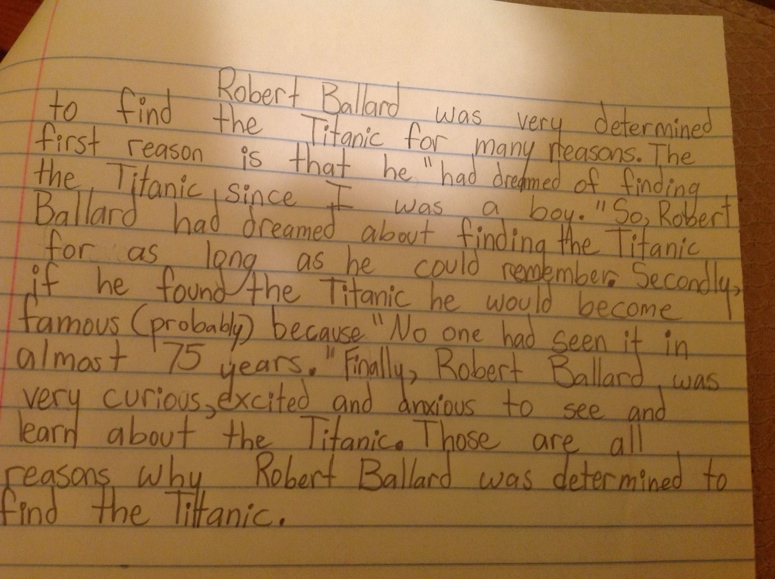
I love my kid, but I can’t figure out who was more bored: her when she wrote this, or me when I read it.

It’s fine and it’s technically correct, but Greene’s point shines through: there is no question that this paragraph is not a paragraph in which my 10 year old is communicating what she wants to communicate in a meaningful way. Rather, she is — as Greene predicts — writing to answer the wrong questions. Her writing is dull and lifeless because she is asking herself “what can I write to satisfy this assignment” or “how can I fill up this piece of paper” or “what can I use to fill in five paragraph-sized blanks,” and, as Greene notes, “these are all the wrong question to start with.”

On the other hand, there has been a lot of “authentic” writing — i.e., writing that answers the “correct” question of how can I communicate what I want to communicate — going on in my house recently (and I don’t mean my blogging, although of course that’s exactly what my blogging is — my attempt to communicate to the world my point of view regarding the “reforms” to our education system).

The weekend before Thanksgiving, my daughters started playing “The Letter Game.” My oldest daughter started writing letters to my younger daughter. My younger daughter kept bringing them to me to help her read them, but what I didn’t realize at the time (I might have been busy blogging) was that my kindergartener was writing decipherable notes (full of invented spellings, of course) back in response to her sister. For about two hours, the two of them were communicating through the written word. As they were wrapping up their game, I realized what had been going on, and was amazed by the little one’s notes. (Unfortunately, the big one managed to throw them away while she was on a cleanup frenzy the following day, so I can’t show them to you here.)

To me, that was an extraordinary breakthrough. It was my little one’s first authentic experience with using written language to express what she wanted to communicate. Over the long weekend, a lot more authentic writing happened in my house. The girls (my daughters and their close friend) began writing “newspapers” documenting happenings in the imaginary world they’d conjured up. Here are a few examples:


FYI, Jake Blaine is a figment of their imagination. I’ve never met a Jake Blaine in my life.

Apparently the Newspaper is in the process of being rebranded…

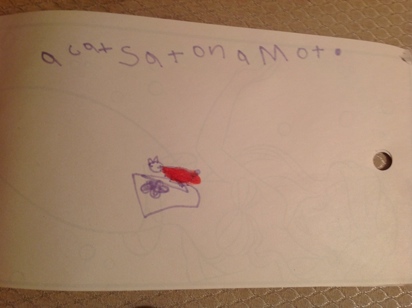
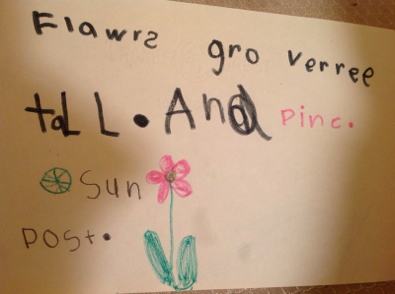
And my little one decided to start “blogging.” Here are some of her “Blog Posts”:
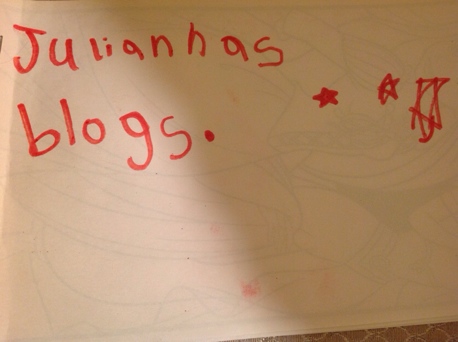
“Julianna’s blogs.”

(“My friends are sad.”)

(“A cat sat on a mat.”)

(“Flower grow very tall. And pink. Sun Post.”) The big one incorporated this into their newspaper, above.

The newspapers and the “blog posts” are writing that these kids generated for themselves, to communicate what they want to say in a meaningful way.

Do you see the difference between writing that is authentic, or, as Greene says, between writing that communicates what the author wants to communicate in a meaningful way and writing that attempts to do nothing more than fill the page, follow a formula, or give the exam-reader what the exam-reader is looking to find? A writing teacher who knows his students (like Greene), is best situated to design writing assignments that will facilitate an environment in which students learn to effectively communicate what they want to communicate in a meaningful way. But when the stimuli-drafters are far removed from the classroom, the students, and their teachers, and when the stimuli ask students to react formulaically to the prompt, we suck the joy out of writing, out of school, and out of teaching.

I don’t blame my daughter’s ELA teacher. I’ve spoken with her in detail, and I know how much she tries to slip authentic and joyful assignments between the inevitable test prep. I know how much more she wants for the kids, but how hamstrung she is by the district’s (and PARCC’s) demands. But to me, the juxtaposition of the joyful, authentic writing happening without adult intervention in my house against the dry and lifeless writing my daughter did for school tonight illustrate better than anything I can write exactly what’s wrong with our high-stakes test driven culture, and the all-business ELA Common Core State Standards that accompany that test-driven, automaton-producing educational ideal.

I know detractors might argue that these are two different types of writing: analytical writing versus creative writing. But that’s exactly my — and I believe Greene’s — point. When writing is authentic and meaningful, expository and analytical writing is both intellectually meaningful and creative (check out your average New Yorker article). But when formulas and mnemonics rule, writing becomes about spitting words out onto paper, and not about contributing meaning to our human endeavor on this lonely little planet. Why on earth are we allowing test-driven school culture (especially one that attempts to standardize and test writing, of all things) to squelch the meaning out of our kids’ words?

Asinine Arne’s Idiotic Idea

Update (12/6/14): The proposed rules have been published in the Federal Register.  There is a 60 day comment period.  Please go and comment (I submitted a slightly edited version of this post, of course). Here is the link: https://www.federalregister.gov/articles/2014/12/03/2014-28218/teacher-preparation-issues Thanks for your attention to and care regarding education and the preparation of new teachers.  Oh, and be forewarned that there is a 5,000 character limit in the online comment box, so if your comments exceed that (as mine obviously did), you will need to add them as a PDF or other document.

Update (12/2/14):  A slightly less “salty” version of this piece appeared on Valerie Strauss’s Washington Post blog, The Answer Sheet, today.  Here’s the link:  http://www.washingtonpost.com/blogs/answer-sheet/wp/2014/12/02/the-concept-education-secretary-duncan-has-entirely-missed/   To be honest, I actually like the WaPo piece better.  I think that toning down the raw edges of this piece increases its impact.  So please feel free to read in either place and let me know what you think.

The pre-Washington Post piece appears below:

When it comes to U.S. Secretary of Education Arne Duncan and his asinine ideas, it’s hard to figure out which idea is the worst of the worst. But I think we have a winner. On November 25th, the New York Times published an article titled, “U.S. Wants Teacher Training Programs to Track How Graduates’ Students Perform.” Yes, you read that correctly. When an aspiring teacher graduates from her teacher education program, that program will be ranked based on how the aspiring teacher’s students perform (on standardized tests). And, even worse, programs that fail to generate higher student performance (never mind whether some are sending teachers to suburban classrooms full of privileged children while others are sending new teachers to the rural or urban trenches) will lose some federal funding if their alumni’s students fail to perform. Now, please bear with me. Out here in lawyer-land, there’s a slippery concept that every first year law student must wrap her head around: it’s the idea of distinguishing between actual (or “but for”) causation and proximate (or “legal”) causation. Actual causation is any one of a vast link in the chain of events from the world was created to Harold injured me by hitting me, that, at some level, whether direct or attenuated, “caused” my injury. For instance, Harold couldn’t have hit me if the world hadn’t been created, because if the world hadn’t been created, Harold wouldn’t exist (nor would I), and therefore I never would have been hit by Harold. So, if actual or “but for” causation was legally sufficient to hold someone responsible for an injury, I could try suing “the Creator,” as if the Creator is somehow at fault for Harold’s decision to hit me. Well, that’s preposterous, even by lawyer standards, right? The law agrees with you: the Creator is too far removed from the injury, and therefore cannot be held legally responsible for it. So to commit a tort (legal wrong) against someone else, it isn’t sufficient that the wrong allegedly committed actually — at some attenuated level — caused the injured’s injury (i.e., that the injury would not have happened “but for” some cause). Instead, the wrong must also be proximally related to that injury: that is, there must be a close enough tie between the allegedly negligent or otherwise wrongful act and the injury that results. So while it would be silly to hold “the Creator” legally responsible for Harold hitting me, it would not be similarly silly to hold Harold responsible for hitting me. Harold’s act was not only an actual or “but for” cause of my injury, it was also an act closely enough related to my injury to confer legally liability onto Harold. This is what we lawyers call proximate (or legal) causation: that is, proximate causation is an act that is a close enough cause of the injury that it’s fair — at a basic, fundamental level — to hold the person who committed that injurious act legally responsible (i.e., liable to pay damages or otherwise make reparations) for his act. [As an aside to my aside, if this sort of reasoning makes your head explode, law school probably isn’t a great option for you.] Well, it appears that Arne Duncan would have failed his torts class. You see, Arne didn’t get the memo regarding the distinction between actual causation and proximate causation. Instead, what Arne proposes is to hold teacher prep programs responsible for the performance of their alumni’s K-12 students (and to punish them if their alumni’s students don’t measure up). Never mind the myriad chains in the causation link between the program’s coursework and the performance of its graduates’ students (presumably on standardized tests). Arne Duncan somehow thinks that he can proximally — fairly — link these kids’ performance not just to their teachers (a dicey proposition on its own), but to their teachers’ prep programs. Apparently Arne can magically tease out all other factors, such as where an alumna teaches, what her students’ home lives are like, how her students’ socio-economic status affects their academic performance, the level of her students’ intrinsic motivation, as well as any issues in the new alumna’s personal life that might affect her performance in the classroom, and, of course, the level of support provided to the new alumna as a new teacher by her department and administration, and so forth. As any first year law student can tell you, Arne’s proposal is asinine, as the alumna’s student’s test results will be so far removed from her teaching program’s performance that ascribing proximate causation from the program to the children’s performance offends a reasonable person’s sense of justice. [Not to mention the perverse incentives this would create for teaching programs’ career advising centers — what teaching program would ever encourage a new teacher to take on a challenging teaching assignment?] So what’s the rationale for Asinine Arne’s Idiotic Idea?

“The last thing they want or need is an easy A,” Mr. Duncan said. “This is nothing short of a moral issue. All educators want to do a great job for their students, but too often they struggle at the beginning of their careers and have to figure out too much on the job by themselves.”

I graduated from a teacher prep program. I earned an M.A.T. (Master of Arts in Teaching) from the University of Maine, where my concentration was in teaching secondary school English. And Arne both is and isn’t wrong. There is no question that my M.A.T. program could have been a year of easy A’s for me. There was a lot of work, but it’s true, I didn’t really find the intellectual work of the classes themselves particularly challenging. However, I made a decision — and I don’t think I was alone among teachers in making this decision — that if I was going to have the moral authority as a teacher to ask my students to work to the best of their ability, then I had to have had the experience of working to the best of my academic ability. So, I really worked my tail off in that program because I felt it was important for me to do so, not because the courses themselves really demanded that level of work. And yes, for whatever it’s worth, I graduated with a perfect GPA. But as I understand it, perfect GPAs common in many graduate programs, not just education. That being said, I had a few terrific professors in my M.A.T. program (Ted Coladarci for Educational Psychology comes to mind) and I had my share of ho-hum to pretty awful professors there as well (I won’t name names, but my personal “favorite” was the all-but-dissertation grad student who taught us nothing but then required us to write an end-of-course reflection paper about the transformative experiences we’d had in her course — a lot of alcohol enabled me to draft 57 lies in 4 pages). But good, awful, and in-between, that 13 month teacher prep program also provided me with a strong grounding in the theoretical — and practical — components of running my own classroom. Our program started in mid-June (on my birthday, in fact), and after a summer of intense theory, from the first day public schools were in session that fall, we were in actual classrooms with actual students. At first we observed, met regularly with our mentor teachers, and began designing lessons to meet our students’ needs. As the fall semester progressed, we taught some lessons in our practicum classes. Then, in the spring semester, we student taught full time (we each had two 8 week placements) for the entire semester (our academic courses met in the late afternoons and evenings). That spring, I was responsible for teaching — under the guidance of and with the help of my mentor teachers — full rosters of students. After the spring semester ended, we returned to straight classroom work for the summer to round out our education coursework. When I began my first teaching job the following fall, I was as well-prepared as I think I could be, but I was also unprepared, because there is a huge gap between a student teacher, who benefits from the gravitas and classroom management accountability instilled by her mentor teachers, and a brand new teacher who must, for the first time, create the gravitas and accountability necessary to effective classroom management on her own. It isn’t that my academic preparation was bad — it really wasn’t — it’s simply that there is a fundamental divide (even with the year of practicum and student teaching experience our program afforded us) between studying how to do something and actually doing that thing yourself. After teaching for a couple of years, for a whole variety of reasons, I left the classroom, moved back near my family in New Jersey, and decided to apply to law school. I am here to tell you that my law degree provided me with far, far less practical experience than my M.A.T. degree. For those of you who aren’t familiar with how law school works, at a typical law school you take a standardized curriculum the first year. Pretty much every first year law student in this country studies Contracts, Torts, Property, Criminal Law, Civil Procedure, Constitutional Law, and Legal Research & Writing in her first year of law school. During the following two years, law students take a variety of electives, although most law students make sure to take a few other basic classes during those years: i.e., Corporations, Evidence, and maybe Criminal Procedure. In Legal Research & Writing a law student writes a few legal memoranda and a couple of legal briefs. In the entire year long course, I think we finished four major pieces of writing (two memos, a summary judgment brief, and an appellate brief). What we don’t learn in law school is anything practical. We don’t learn how to draft the supporting papers for our motions, we don’t learn how to talk to adversaries on the phone, we don’t learn about scheduling orders and negotiating confidentially agreements, and we don’t learn how to interview clients. We certainly don’t learn how to review documents, create deposition outlines, or draft contracts. Anything practical we learn during our law school years we learn from our summer internships: I learned a fair amount interning for a Third Circuit Court of Appeals judge after my first year of law school, and even more as a second year summer associate at the large firm I joined upon graduation. And for the record, as with my teaching program, I had some terrific law school professors (Claire Dickerson and Diana Sklar come to mind), and I had some pretty awful law school professors. Frankly, that was my experience from elementary school through the end of law school — some teachers were awesome for me, others, not so much. When I left my M.A.T. program to begin my first year as a teacher running my own classroom, it took me a bit of time to get my sea legs as far as classroom management went, but my professional program had provided me with the tools to get there. When I graduated from law school (and FYI, I graduated with high honors, so the issue isn’t one of not being able to hack law school), finished studying for and taking the bar exam, and actually started my first job, I knew nothing. More experienced attorneys had to walk me — step by step — through how to do everything from how to put together a motion to how to take a deposition. The point of this Very Long BlogPost is that Asinine Arne has, to my mind, entirely missed the point. No professional academic program can 100% prepare you to hit the ground running in your career. Rather, professional expertise is something you develop over years of actually practicing your profession — and the further you progress in your career, the more you appreciate the theoretic base you learned in your academic preparation. I’m a far better lawyer in my tenth year of practice than I was in my first, and I imagine that if instead I was a 15th year teacher this year, I’d be a heck of a lot better at teaching than I was when I left the classroom after two years of teaching experience. That being said, compared to law school, there is no question that my M.A.T. program gave me the skills I needed to develop professional expertise, and frankly, it did a far better job of teaching practical skills I’d need in my classroom than law school did at teaching practical skills I’d need in the courtroom. Arne says:

“All educators want to do a great job for their students, but too often they struggle at the beginning of their careers and have to figure out too much on the job by themselves.”

Figuring out how to do the job by yourself is the key to developing from a student into a professional, whether you’re a teacher or a lawyer. At some point, every professional must make this transition, and all of the training in the world can’t substitute for the on-the-job experience that transforms a recent professional program graduate into a seasoned veteran. Actual professionals know this. It’s too bad Asinine Arne didn’t get the memo. P.S.: Arne Duncan has been secretary of education for six years, and in that role he is ultimately responsible for the educational progress of all U.S. students. According to the most recent PISA results, U.S. students’ scores haven’t improved on Duncan’s watch. Therefore, by Duncan’s own logic, I propose that we deprive his alma mater — Harvard University — of some federal funding for its current students because Duncan’s failure to improve U.S. PISA scores demonstrates that Harvard (which educated Duncan) is responsible for U.S. students’ flat scores on the PISA exam. If Duncan and Harvard don’t like the logic of my modest proposal, then Duncan should withdraw his proposed scheme for rating teacher preparation programs based on the educational outcomes of their alumni’s students, as my logic simply tracks his own.

Hespe’s Flawed Analogy

In an article in today’s New Jersey Spotlight, Acting Commissioner Hespe confirmed that my initial analysis of his guidance was spot-on. He said:

“A good parallel is compulsory attendance. Parents don’t have the option, students are supposed to go to school. The same with [opting out], they don’t have that option.”

But it is the Acting Commissioner’s analogy that is flawed. Parents — who have the right to direct their children’s educations — may opt-out of school (and related testing) by homeschooling their children without fear of negative consequences for the children or themselves. See N.J.S.A. 18A:38-25. It’s been more than a decade since I took Constitutional Law and I haven’t done detailed research on this (see my prior disclaimer), but as I recall, Pierce v. Society of Sisters, 268 U.S. 510 (1925), was pretty unequivocal in holding that parents’ rights trump states’ rights when it comes to the education of their children. It’s not unreasonable to believe that courts would be willing to hold that parents’ rights to direct their children’s educations, as enshrined, inter alia, in Pierce v. Society of Sisters and N.J.S.A. 18A:38-25, might well extend to refusing PARCC without giving up our right to a public school education for our children.

I believe, at a fundamental and basic level, that strong public schools are necessary for democracy. NJDOE, through Acting Commissioner Hespe, perhaps unintentionally, or perhaps by design, is attempting to force opt-out parents into choosing between abandoning public schools (as students at private school and homeschooled students are exempt from PARCC testing requirements) or allowing their children to sit for developmentally inappropriate tests. This isn’t a choice parents should be forced to make — and as the Supreme Court held way back in Pierce v. Society of Sisters, when it comes to directing children’s education, parents’ rights trump the state’s rights.

NJDOE’s Declaration of War

I am an opinionated blogger, and I blog here in my personal capacity. Unlike some other bloggers doing excellent work in the world of education policy and beyond, I do not claim to be a citizen journalist objectively reporting the news. I’m just a mom with a keyboard and opinions. I occasionally manage to put my thoughts into words as I explore education policy from my perspective as a public school parent. And although I am an attorney, I do not pretend to be blogging in my professional capacity, and I certainly do not intend any of my musings here as legal advice.

That being said.

That being said.

That being said, New Jersey’s Acting Commissioner of its Department of Education, David C. Hespe, appears to have declared war on parents and children who oppose his standardized testing policies.

Specifically, today the Acting Commissioner issued guidance to chief school administrators, charter school lead persons, school principals, and district and school test coordinators regarding “Student Participation in the Statewide Assessment Program.”  Go read it yourself.

But here’s my synopsis:

This. Means. War.

Acting Commissioner Hespe has declared war on us — and our children.

Acting Commissioner Hespe advocates punishing children for their parents’ political opposition to NJDOE’s destructive over-testing policies.

NJDOE has crossed the line.

Hespe says:

We have received a number of inquiries regarding the ability of parents and students to choose to not participate in the statewide assessment program, including the Partnership for Assessment of Readiness for College and Careers (PARCC) assessment. In an effort to clarify school district responsibility in this regard, the Department is providing the following guidance.

First, I want to take a moment to celebrate each and every person who has forced the Acting Commissioner of New Jersey’s Department of Education, David Hespe, to respond to the opt-out/refusal movement.

Thank you for fighting back against the over-testing of our children along with its predictable results: test-prep focused classrooms practices and narrowing of curriculum (just once, I’d like to see social studies instruction at my daughter’s school that is something more than map skills). There is something wrong when our 9 year old fourth graders are expected to sit for more testing than our state’s aspiring attorneys must take to become licensed to practice law. (A New Jersey fourth grader is expected to sit for 10 hours of PARCC testing plus 90 minutes of NJ ASK science testing, for a total of 11 hours and 30 minutes of testing. The New Jersey Bar Exam is a total of 11 hours and 15 minutes of testing.)

I am still in the process of educating my fourth grader about the pros and cons of the PARCC testing, and as a parent of a high-functioning and inquisitive fourth grader who does not suffer from test anxiety, I am letting her have input into the decision our family is going to make regarding whether she will be sitting for these tests this spring, rather than forcing my decision on her. After all, this is her education, and she is the one who will ultimately suffer any consequences. As much as I’d dearly love to just refuse on her behalf, I won’t do so unless she is on board. So for now, our family remains on the fence.

Second, Hespe’s key argument supporting testing is: “Federal funding of key education programs is dependent upon districts meeting [No Child Left Behind’s Adequate Yearly Progress] requirement.” Really? That’s the best you’ve got?

Note that Hespe does not identify which key education programs’ funding is contingent on our kids taking these tests. As FairTest.Org notes, “In a state with a waiver, a ‘priority’ school must set aside 5-15% of its federal Title I and II funding to use in state-approved programs in the school. The money is not ‘lost.’ It generally may be used for various school improvement efforts.” Here’s the link. New Jersey is a waiver state, so I’d love to know exactly what federal funding the Acting Commissioner believes my daughter’s school will lose if she and more than 5% of her peers refuse the test. I have not done the research myself, but from the limited reading I have done, it appears that this is a toothless threat.

Third, here is Acting Commissioner Hespe’s actual guidance — or, more accurately, his declaration of war:

In accordance with the above, State law and regulations require all students to take State assessments. For the 2014-2015 school year, the PARCC assessment will replace the prior statewide assessments – the NJASK in grades 3-8 and HSPA in high school; as such, all students shall take the PARCC assessment as scheduled. Since the PARCC assessment is part of the State required educational program, schools are not required to provide an alternative educational program for students who do not participate in the statewide assessment. We encourage all chief school administrators to review the district’s discipline and attendance policies to ensure that they address situations that may arise during days that statewide assessments, such as PARCC, are being administered.

In short, Hespe says:

  • State law requires all students to “take” State assessments;
  • PARCC is required by the State, so schools are not required to provide an alternative education program for students who do not participate in the statewide assessment; and
  • NJDOE “encourages” all chief school administrators to review district discipline and attendance policies “to ensure that they address situations that may arise during days that statewide assessments, such as PARCC, are being administered.”

Let’s take Hespe’s Declarations of War one at a time.

(1) State law requires all students to “take” State assessments and “all students shall take the PARCC assessment as scheduled.”

Or what?

Or what, Acting Commissioner Hespe?

At the end of the day, no one at my daughter’s school can force her to click a mouse, type on a keyboard, or pick up a pencil.

So I say, bring it. It doesn’t take a Ph.D to realize that it is fundamentally wrong to base education policy on essays our fourth graders are required to type — when they’ve never taken typing classes. Last spring when I began exploring these tests, I watched my daughter struggle for over 7 minutes to input the answer to a math question she’d solved in 30 seconds.  I’m a mom and a former teacher, and I see no value whatsoever in tests that measure my 4th grader’s computer savvy rather than her academic skills.

(2) PARCC is required by the State, so schools are not required to provide an alternative education program for students who do not participate in the statewide assessment.

Last spring, as New York’s opt out movement alone grew to more than 60,000 students, a lot was written about so-called “sit and stare” policies. See, e.g., this piece from The Answer Sheet blog at The Washington Post

But unless I’m fundamentally misreading this memo, Hespe appears to be encouraging districts to adopt sit and stare policies in an effort to intimidate parents into not opting their kids out.

Bring it on, Acting Commissioner Hespe. Bring it.

It appears to me that you’re taking a page from your boss’s playbook by telling those of us who disagree with you to “sit down and shut up.”

It appears to me, Acting Commissioner Hespe, that you’re trying to bully those of us who do not see the value in your precious PARCC tests by punishing our children.

That’s low, Acting Commissioner. Really low. And do you know what? You don’t intimidate me. All you’ve done is piss me off. And Acting Commissioner, I’ll tell you this: pissing off parents — and voters — like me is probably not the way to ensure the long-term success of your policies. You were just a faceless bureaucrat. Now I want to get you fired. You deserve no less for attempting to bully parents by punishing our children.

(3) NJDOE “encourages” all chief school administrators to review district discipline and attendance policies “to ensure that they address situations that may arise during days that statewide assessments, such as PARCC, are being administered.”

I’m not certain what Acting Commissioner Hespe is getting at here, but I suspect his purpose may be to suggest that districts should implement attendance and discipline policies that will impose punitive consequences on children whose parents opt them out of these tests.

Is Acting Commissioner Hespe really suggesting that parents who keep their children home during testing are risking their children’s promotion to the next grade as a result of too many absences?

Is Acting Commissioner Hespe really suggesting that school districts should implement discipline policies that will impose punishments on children who refuse testing?

Would Acting Commissioner Hespe attempt to link state funding to local districts with the local districts’ willingness to implement punitive measures against those children whose parents refuse PARCC on their behalf?

The next step for me will be to see how my district interprets this guidance. Will it opt to provide alternate educational experiences and keep its promise that no academic decisions will be made based on this year’s test results?

But one thing seems certain. Acting Commissioner Hespe is scared. Really scared. He’s scared that the PARCC consortium is coming apart at the seams.  He’s scared that his precious testing regime is about to implode before it gets started. He’s scared that his tests aren’t going to generate enough data about enough kids to satiate the data monsters.

And he’s terrified of the growing opt out movement. So Hespe’s doubled down on PARCC. First he linked high school graduation to PARCC testing. Now he’s threatening parents and children who refuse PARCC. Defensiveness is rarely a sign of strength.

So as awful as this guidance is, it tells me that we’re winning. In a post-Citizens United world, there’s still some hope for grassroots activism and organizing. We are winning the war to do away with excessive and punitive standardized testing. And, of course, the whole education reform movement relies on its standardized testing foundation.

All the Acting Commissioner did with this policy was to galvanize me, for one, to fight harder. Who’s with me?

P.S.  For a terrific analysis of the Acting Commissioner’s magical thinking with respect to the supposed benefits of PARCC vs. the now apparently fatally flawed NJASK/HSPA (the portion of his letter I didn’t get around to analyzing), check out Peter Greene’s terrific piece over at Curmudgucation.  Will Hespe’s Magical PARCC promise my kids ponies?  What about unicorns?

Questioning the Test (Or, My List of Skeptical but Respectful Questions Regarding PARCC)

My daughters’ school district is holding a series of “PARCC Family Presentations” over the next few weeks. The presentation targeted at parents of third through fifth grade students is set for this Thursday. In preparation for the presentation, the district has — to its credit — announced that it is soliciting questions regarding the PARCC assessments. So I sat down and generated a list of my current questions. Then I went to submit them via the District’s Google Docs form, and promptly discovered that the district’s form imposes a 500 character limit per subject.

As you will see below, after spending the past year or so educating myself about the PARCC, my questions far exceed 500 characters so I emailed my questions directly to our district’s Chief Academic Officer. I really hope that we get some honest answers to these questions. Here are my hopefully skeptical but respectful questions (slightly edited to take out the district-specific language I used in my email), plus a few additional questions that I thought of after I sent my email. Please suggest additions to my list, comment on my list of questions, and let me know if your school districts are holding similar information sessions. If your district is holding similar sessions, please attend one so that you can learn what your district is saying and ask your own questions. Of course, if my concerns mirror yours, please feel free to adapt my questions for use in your own school district.

Most of all, even if your children are not third through eleventh graders, please educate yourselves about these tests, and think critically about where our schools are headed now that many states, including but not limited to my state, New Jersey, have doubled-down on implementing high-stakes standardized testing for our students.  

PARCC FAMILY PRESENTATIONS — QUESTIONS

I. Testing Administration

1. What will happen if I decide to have my child refuse PARCC testing? Will there be consequences for my child, his/her teacher, and/or his/her school? Will my child be forced to “sit and stare,” or will s/he be provided with an alternate educational experience?

2. How many hours of testing for 3rd graders? 4th graders? 5th graders? How much total time per school will be spent on a testing schedule given that all children in the grade level cannot test simultaneously? Will children miss their [elective] classes during PARCC administration, even if they themselves are not testing? What impact will testing have on the [elective] programs at [my daughter’s school]? Is [the technology teacher] teaching fewer technology electives than in the past due to PARCC preparation?

3. Why is it necessary (from a pedagogical perspective) for our students to be tested in both March and May?

4. What in-district adults are proctoring and reviewing the PARCC tests to ensure that the test questions are not poorly worded, ambiguous, and/or that correct answer choices are provided for multiple choice tasks? Will those people be able to speak out if questions are poorly worded or if no correct answer choices are provided, or are they going to be required to agree to gag orders before they can administer the tests?

II. Scoring and Reporting

1. Will a school or schools in this school district face in-district consequences (e.g., steps taken to dismantle a school’s magnet theme) now or in the future as a result of its performance on PARCC?

2. I understand that although New York is not a PARCC state, it has been giving Common Core aligned assessments for two years now, and the passing rate has dropped from over 60% to under 30%. What percentage of New Jersey/[our local district] children are expected to pass PARCC in 2014?

3. What data do you expect to receive from PARCC that will be available to classroom teachers to guide instruction? When will PARCC scores and results be available?

4. Who scores the subjective portions of the PARCC tests? What are those people’s qualifications?

5. Will PARCC results be part or all of the criteria used to identify [gifted and talented] students going forward? What happens if my child was previously identified as a [gifted and talented] student, but loses that designation because s/he lacks the technology skills to succeed on the PARCC assessments?

III. Technology Skills

1. What steps are you taking to ensure that our 8, 9, and 10 year old students have the typing skills necessary to compose essays with keyboards? How much time is being spent on preparing children to acquire the skills necessary to master the PARCC interface? Is the preparation process uniform throughout the district? If it is not, doesn’t this mean that we won’t be able to make apples-to-apples comparisons of student scores even across the district?

2. Have you done comparisons of the time on task necessary for students to answer PARCC sample questions with paper and pencil versus with computers? If so, what were the results?

3. What happens if computers break, internet service goes down, or the children encounter other technological difficulties during their testing windows?

IV. Content Areas

1. I have seen virtually no evidence of specific social studies instruction (stand alone ELA worksheets with “social studies themes” do not count in my book) and very little science instruction since [our district] started implementing Common Core and preparing for the PARCC assessments. What steps are you taking to ensure that our children are learning the history and civics necessary to become informed citizens and voters?

2. Will students lose points on math assessments if they do not use specific Common Core strategies to solve problems (e.g., performing multiplication the traditional way rather than drawing an array)? My child lost full credit on the following Envisions math test problem this year: “Write a multiplication sentence for 3 + 3 + 3 + 3 + 3 = 15” because she wrote 3 x 5 = 15 instead of 5 x 3 = 15. Will children be losing points on PARCC for failure to make meaningless distinctions such as this one?


V. Additional Questions I Should Have Asked

1. What effect do you expect the PARCC test to have on our district’s efforts to close the achievement gap? Given the wealth disparity — and resulting inequities in home access to technology — in our district, aren’t these assessments likely to magnify our district’s pre-existing achievement gap?

2. What preparations are you making to care for our children’s emotional and social health during these tests (and when the results become available), given the likelihood that far more students are going to struggle with — and fail — these tests than struggled with and failed the NJ ASK?

and finally

3.  How can it be developmentally appropriate for our 9 year old fourth grade students to spend 10 hours on PARCC testing when many adults cannot handle the stress of the 11 hour and 15 minute New Jersey Bar Exam?

UPDATE:

VI.  Additional Questions Suggested by Readers — Please also see the additional excellent questions in the Comments section, and feel free to add your own!

1.  What demographic information will be collected in connection with our students taking this test?  Who will this demographic data be shared with, and what controls are in place to make sure our students’ demographic data isn’t sold for marketing or other purposes?  

2.  Will some or all of the tests be made public after testing so that we, the community, can review the questions and the sample/model answers and so that our children’s teachers can actually use the assessment data to guide classroom instruction?  In the absence of such a release, what value does the assessment data provide to classroom teachers?

3.  What costs — in addition to the one million dollars the district allocated to capital spending this year to support technology upgrades — are associated with preparing our students and their teachers for the PARCC tests?  What portion of our personnel budget is attributable to time spent on preparing for and proctoring these exams?

Pearson’s Apology

For everyone who read and commented on my prior post, Pearson’s Wrong Answer, first of all, thank you.  The response has been overwhelming.  Second, I just wanted to take a moment to let you know that my post did eventually percolate its way to Pearson, and a Pearson representative named Brandon Pinette appears to have left a comment on the blog post today:

Pearson did make an error on the specific quiz question in a lesson in the Envision Math textbook and we sincerely apologize for this mistake. We corrected the error for future editions of Envision, but failed to adjust the question in editions currently in the field. We owe it to our students and teachers to ensure these types of errors do not happen in the future, and are committed to adapting new protocols to fix mistakes before they happen. Trust in our products and services is key and we have to earn it every day with students, teachers and parents.

Thank you,
Brandon Pinette
Pearson

It seems only fair to make sure that this specific apology for this specific mistake gets highlighted more than as one of almost a hundred comments to a blog post.  

However, from the overwhelming responses and comments this blog post has received (here, on Facebook, and on Valerie Strauss’s blog at The Washington Post, The Answer Sheet) one thing seems clear: this is not an isolated problem (either for Pearson or for textbook and academic material publishers in general).  Because my child is slated to take the Pearson-developed PARCC tests this spring, my focus is on Pearson.  Mistakes in other textbooks are annoying, but my specific concern about Pearson is its vertical integration throughout the education world: i.e., Pearson writes the textbooks (mistakes and all), Pearson writes and grades the PARCC tests, Pearson provides remedial programs for students who fail the Pearson-generated tests, and Pearson writes the GED tests for those students who drop out of high school.

I encourage anyone who finds other mistakes in Pearson materials to take photos of the specific mistakes, and then Tweet them with the hashtag #PearsonsWrongAnswers.  

I am glad that Pearson is “committed to adapting new protocols to fix mistakes before they happen” and that Pearson recognizes that “Trust in our products and services is key and we have to earn it every day with students, teachers and parents.”  

But I still think that we need to continue to hold Pearson accountable.  

Many commenters have pointed out, with validity, that there is supposed to be statistical analysis of standardized test questions, and that mistaken questions on the standardized tests will be thrown out as invalid.  I am sure that they are correct that this does happen.  However, with tests as high-stakes as these, I am not sure that this is a sufficient response.  

For instance, imagine if this was a standardized test question.  I could easily see a 9 or 10 year old test taker, who figures out that the correct answer is 546, struggle as she looks at multiple choice responses such as (a) 78 (b) 130 (c) 500 or (d) 63.  And I think that some kids are more likely than others to be distracted by (and therefore waste time on) issues generated by mistakes such as this one.  As a result, on a high-stakes timed standardized test, the time wasted on the wrong questions like this one may artificially deflate a child’s score.  And similarly, the child who gets the intended but mistaken correct answer (in this case, 78 miles, which would be correct if Curtis walked 3 miles a day for 26 DAYS) may obtain an artificial advantage because she isn’t bogged down by catching and mulling over the mistake.  Throwing out the specific question will not address these issues.  

And as long as we are addressing comments, for those commenters who think my post was an overreaction, so be it.  Perhaps it was.  But as noted above, Pearson has an awful lot of vertical integration throughout the education market, and Pearson’s employee himself admitted that “Trust in our products and services is key.” 

Pearson has to earn my trust.  And since its materials are at the heart of my children’s math education, I will be doing my best to look over its shoulder now, as much as anything as part of my decision-making process concerning whether I think I should join the movement to refuse or opt out of its standardized tests.  

Thank you all again.

Pearson’s Wrong Answer

Updated (Oct. 10): Pearson responded to this post in the comments section.  See Pearson’s Apology. 

Last Friday morning, my fourth grader handed me her “Thursday folder” shortly before we needed to head to the bus stop. I was glad to see a perfect spelling test, and a bunch of excellent math assignments and math tests. Time was short, however, so I flipped to the wrong answers. And sprinkled among the math tests, I came across two wrong answers that caused me concern.

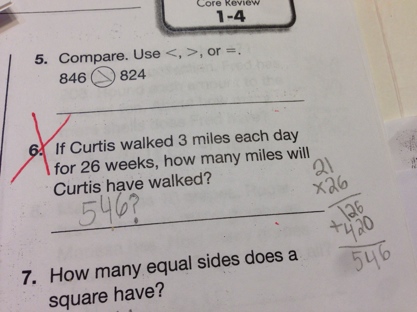
The first problem was this:

Now, I looked at this problem before I’d had my morning coffee, and I wasn’t sure at first that I wasn’t just missing something. So I posted this picture to my Facebook feed, and asked my friends to confirm that I wasn’t crazy.

But my daughter was right: if Curtis walked three miles a day for 26 weeks, Curtis did in fact walk 546 miles.

3 miles/day x 7 days/week = 21 miles/week
21 miles/week x 26 weeks = 546 miles

I double, triple, and quadruple checked myself.  I pulled out a calculator.  

My friends agreed: my initial reaction to this question wasn’t nuts. My daughter’s answer was correct. And they came up with some good theories for why the answer might have been marked wrong.

Perhaps the teacher was trying to teach children, especially girls, to be confident in their answers, and she’d been marked wrong due to the question mark.

Perhaps she’d been marked wrong because she failed to indicate the units.

Perhaps she’d been marked wrong because she hadn’t provided every step of her work (i.e., she’d figured out the first step (3 miles/day x 7 days/week = 21 miles/week) in her head, and therefore had paid what one of my friends memorably described as a “smart kid penalty.”

But they were all wrong.

My daughter is fortunate enough to attend an excellent public school and her responsive teacher both sent a note home and called me that afternoon to discuss (I’d scribbled a quick note asking what the deal was along with my required signature on the front of the paper).

It turned out that my daughter had been marked wrong for a very simple reason: the Pearson answer key was wrong.

Let me say that again: Pearson was wrong.

Pearson listed some totally different — and wrong — number as the answer. The teacher had missed it when reviewing the test with the morning class, but in the afternoon class she’d realized the problem. My daughter’s teacher apologized for forgetting to mention it again to the morning class (and for not having previously changed their grades, but to be honest, I really could not care less if my kid scored a 95% or 100% on a 4th grade in-class math test).

In the olden days, I’d have laughed it off. Once in awhile, the textbook publisher screws up. In the olden days, that screw up was no big deal: it is mildly annoying to those of us who pay the taxes to buy the books, but it’s a pretty minor annoyance in the grand scheme of things.

However, these are not the olden days. These are the days of high stakes testing. These are the days in which our kids’ high school graduations hinge on tests created by the very same company — Pearson — that screwed up the answer to this question.

Tests we parents will never get to see.

Tests we parents will never get to review.

Tests we parents will never get to question.

So Pearson’s screw up on its fourth grade answer key doesn’t exactly inspire confidence.

Presumably, before the enVisions curriculum was published, Pearson checked and rechecked it. Presumably, its editors were well-paid to review problems and answer keys.

After all, Pearson itself describes this math curriculum as:

Written specifically to address the Common Core State Standards, enVisionMATH Common Core is based on critical foundational research and proven classroom results.” 

And yet… it was still dead wrong.

It seems that all of Pearson’s critical foundational research and proven classroom results in the world couldn’t get the question 3 x 7 x 26 correct.

To the uninitiated, I bet I sound nuts.  Who cares, right?  It’s just a question on a math test.  But if we are going to trust this company to get it right on high-stakes tests (where there is no public accountability), then the company better get it right all the time when it is operating within the public eye.  So this isn’t just about a fourth grade math test.  It’s all of the other Pearson-created tests my daughter is scheduled to take: in particular, the PARCC tests this spring, which are the ones that come with no public review, and no public accountability.  

Here, the test came home in my daughter’s backpack. As a result, there was an opportunity for public review and public accountability because I could review the test and question the wrong answer. The teacher could check the question and realize that the book was wrong, and substitute her own professional judgment for that of the textbook publisher.

And most importantly, the mistake was not a big deal, because the outcome of this test would not determine my daughter’s placement into an advanced math class or a particular school or even prevent her from graduating from the fourth grade. The outcome of this test would not determine her teacher’s future salary or employment. This test was nothing more than the kind of test our nine and ten year olds should be taking: a fourth grade in-class, teacher-graded chapter test. At most, this test will determine a small portion of my daughter’s report card grade.

But what about those tests that Pearson will be administering to our students this spring? We won’t be able to review the test questions, the answer keys, or our children’s answer sheets. We won’t be able to catch Pearson’s mistakes.

This spring, even if the answer really is 546 miles, Pearson will be able to write that Curtis traveled 1024 miles, or 678 miles, or 235 miles, or any other distance it wants. And we’ll never know that our kids weren’t wrong: Pearson was. But our kids’ futures — and their teachers’ careers — will be riding on the outcomes of those tests.

There has to be a better way.

In a low-stakes world, Pearson’s screw up was a low-stakes mistake. But now we’re forcing our kids — our eight, nine, and ten year olds — to live in a high-stakes world.

And in a high-stakes world, Pearson’s screw ups are high-stakes. So shame on you, Pearson, for undermining my daughter’s hard-earned (and easily eroded) math confidence with your careless error. I will parent my kid so that she learns not to second-guess herself with question marks after her answers. 

But Pearson, I will be second-guessing you. As publicly as possible.

And perhaps… just perhaps… I will start shorting your stock.

Yesterday, Power Spoke Truth

Since Sunday, I’ve been at the National Association of Women and Minority Owned Law Firms (NAMWOLF) convention. It’s been an interesting and long couple of days here in Philadelphia, and to be honest, by late yesterday afternoon, I was ready for a break. But I’m a litigation nerd, so I decided to push through to attend a presentation regarding diversity on the federal bench.

The panelists were impressive:

This panel was legal nerd heaven, and it was moving that every single panelist was a person of color. People of color in positions of power in the legal profession remain all too rare, especially serving as federal judges or federal prosecutors.

But then the introductions ended and substantive discussion began. The first question the moderator asked the panel was something along the lines of, “It’s been sixty years since Brown v. Board of Education was decided. What do you think has been Brown’s legacy?”

The question was thoughtful, but I was expecting platitudes for answers: four jurists and two federal attorneys talking about the opportunities they’d had because of Brown. In particular, I expected the judges to avoid real discussion, because judges are generally careful not to express policy opinions, as they don’t want to disturb their veneers of neutrality. I could not have been more wrong. In this case, the judges were most opinionated: perhaps this is an example of how actual life tenure works (under the Constitution, an Article III judge can only be involuntarily removed by a Congressional impeachment process, which even Campbell Brown or the Vergara plaintiffs would admit is far more protection than unionized public school teachers are afforded).

Chief Judge Tucker went first. I could have jumped out of the audience and kissed her when she responded passionately with something along the lines of, “We need a new Brown v. Board of Education, 347 U.S. 483 (1954).  We need to walk back resegregation of our schools over the past decades, and we need new law to again start integrating — and equitably fund — our public schools” (I was not taking notes, and I do not have anything approaching an exact transcript, but that was the gist of it). All five of the Philadelphia based panelists then agreed and added their insights about the destruction of Brown’s impact in recent decades, and described the tragedy that’s been unfolding in Philadelphia with the defunding of its public schools. Judge McKee spoke about the inequity created by not requiring desegregation of private schools, Judge Wells spoke about her conclusion that charter schools exacerbate the problem, despite her previous service on the board of a charter school, and the panelists also spoke about the school-to-prison pipeline and clarified that teachers are not to blame, as they continue to produce extraordinary results, especially given that their resources and funding are non-existent.

The panelists, who were power, spoke truth. They didn’t parrot the education reform talking points. They discussed the impact of charter schools on the process of decimating Philadelphia’s traditional public schools, the hypocrisy they as Philadelphia parents felt when they send their kids to private Quaker schools to escape the destruction of the public school system, the insanity of property-tax base school funding systems, and the need to reboot the legal framework for desegregation by overruling Milliken v. Bradley, 418 U.S. 717 (1974), which held (very generally speaking) that school districts are not required to desegregate across school town lines (i.e., the suburban public school districts surrounding Detroit could not be forced to participate in a desegregation plan for the benefit of Detroit students).

Philadelphians are on the front lines, watching the destruction of their public school system before their eyes.  And these federal jurists, this federal prosecutor, and this federal defender, at least, see through the slick PR machine and hype of the well-heeled reform crowd. No one claimed that charter schools and the education reform movement are the civil rights movement of our time. Philadelphia schools have suffered from the problems common to large urban school districts for many years, but the solution is not to starve them into submission. Yesterday afternoon, three federal judges spoke truth — and their truth was that inequitable funding and the self-perpetuating cycle of the haves fleeing the Philadelphia Public Schools by any means possible are the causes of the problem, and that the education reformers’ “solutions” of charter schools and teacher blaming are only compounding the structural inequities.

I ran up afterwards to shake their hands, which is something I virtually never do. But this was a panel of rock stars, and a completely unexpected reward after two days of legal panels and speakers.

P.S. I have no training as a journalist, and I was not taking notes or recording the session in any way. My reconstruction of the discussion is the best I can do under the circumstances, but the most I can promise is that I did my best to faithfully capture the gist of it.

Reading Log Revolt

Parents and teachers of elementary school aged students, I have a confession to make:

I loathe the reading logs my daughter brings home.

So, just to be clear, the reading logs that return from my house, faithfully filled out each week or month — those reading logs are big fat lies.

My older daughter is now in fourth grade. Each year since kindergarten, she’s brought home some version of the nightly “reading log.” Depending on the year and teacher, it’s been as simple as writing down the name, the book, and the number of minutes read (initialed or signed by a parent, of course), or it’s been as involved as a reading response journal that requires her to summarize, or pick out key details, or connect the text to her own life, and to record the number of pages read, time spent reading, etc.

But each reading log comes with one universal expectation: every single night, there’s some minimum requirement for reading (i.e., number of pages read, or amount of time spent reading). And on a nightly basis, that reading must be tracked.

My older daughter (unlike my little one) started kindergarten as a fluent reader, who had already moved on to reading simple chapter books (Magic Tree House, Beverly Cleary, etc.). More importantly, she started kindergarten as a lover of books. My biggest concern (and oh-how-I-wish-my-mom-was-here-to-laugh-as-I-finally-emphathized-with-her-experience-with-me) was how to pry her away from books. But within weeks, the reading log began to change all of that: “Mom, am I done with my fifteen minutes yet?” “Mom, why do I have to write this?” “Mom, I don’t know what to say.” And worst of all: “Do I HAVE TO read?” This, from my voracious reader. This, when previously my bigger concern had been prying books out of her hands: “Stop reading! Go outside and play with your friends!”

Something had to be done. I was watching my daughter’s joy in reading disappear before my eyes. So I made a deal with her: as long as she continued to read voluntarily on her own, I’d stop timing her, stop nagging her, and just sign whatever she brought me for a reading log as long as it looked vaguely reasonable (and honestly, even if it did not). Despite my general emphasis as a parent on honesty, I discovered that I didn’t care in the least if the reading log was accurate or not, because I knew that she was doing far more reading — with far more joy — on her own than the reading log required. Accurate logging was sucking the joy out of reading. It was like my billable hours requirement. For first graders. As a lawyer, tracking my time at work is a necessary evil. But I’m in my forties. My daughter is nine.

And for five years now, that’s how it’s worked in my house.

But there’s always a tension. Now teachers require the kids to write down which pages they read each night. Teachers, my kid doesn’t want to constantly track, track, track. And my kid doesn’t want to constantly be tracked, tracked, tracked.  My kid wants to escape into the world of fiction, where time loses its meaning as she inhabits its characters. My kid wants to read last thing in bed at night, and first thing when she wakes up in the morning, and in the bathtub. She wants to bring her “emergency pack” of books to her little sister’s family picnic for school, and she doesn’t complain when she doesn’t see the iPad for weeks on end, because she has her books.

And I fully believe that part of the reason she still wants to do those things in fourth grade is because I long since agreed that her reading log could be a work of fiction. But I hate lying, and I hate undermining your authority, and I’m wondering if maybe, perhaps, this can be the year that I come clean and we can make a deal: stop requiring the reading log, so I can stop lying on the reading log. But if not, be assured: this is the one and only aspect of my life in which my signature on that reading log my daughter faithfully brings back to you each month is not worth the paper it’s written on. And my daughter is learning a lesson from that — that sometimes, when the system is stupid and counterproductive, the greater good makes it okay to lie and game the system. I don’t like that lesson, but we’ve talked about it, and in this case, I think it’s worth the trade off.

So, for now, the joy my daughter continues to take in the printed page far outweighs the momentary discomfort it causes me to sign — and certify — as true, a reading log that is generally a patchwork of guesses, at best. Because I love my kid.  But wouldn’t it be better if we simply refused to make reading a chore?

I’ll trade lying on reading logs for photos like this any day.

How I Almost Became an Education Reformer

by Sarah Blaine

By 2011, I’d been practicing law for about six years. That spring, I hit a watershed moment in my practice. I was put on a crazy project that culminated in the one and only time I billed over 300 hours in a month. During that month, I never saw my children awake for more than a few stress filled moments in the morning, and I worried that my “Mommy always comes back” mantra was appearing less and less true in my three year old daughter’s eyes. I had no idea what was going on in my seven year old’s life.  At the culmination of the project that forced my 300+ hour month, one of the partners I worked for came into my office to praise my efforts. She told me that I should keep doing what I’d been doing. G-d forbid.

This partner happened to be a single mother who’d moved a kid sized desk and kid sized folded couch into her office so that her preschooler could sit, headphones engaged, for hours watching videos on a portable DVD player until she passed out asleep on the fold out couch, as mom juggled conference calls. Being a single mom cannot be easy, and in between the 300+ hour months, partner-mom took plenty of vacations with her daughter, and for some of her work binges, she shipped her daughter out to her parents for some actual attention (and presumably less screen time). Nevertheless, while her work-life balance choices seemed to satisfy her, the model she presented did not inspire me. I didn’t want to disappear from my kids’ lives for months at a time. Big law partnership looked more and more like a booby prize. One month at a pace of over 300 hours was problematic enough for my marriage and my children: as fun as the work challenges and accomplishments it had brought had been, it was not an experience I cared to repeat on a regular basis. I certainly didn’t aspire to it as a permanent state of being.

And while the work was intellectually challenging, it was not fulfilling. Helping hedge fund principals and private equity gurus achieve their litigation goals did not leave me feeling that I’d done the world a solid. The intellectual challenge was not enough, since I felt that I was using my brain to leave the world a little worse off. A little less fair. And I watched, from the inside, as the scales of justice continued, in my estimation, to tip a little further away from the have-nots.

As a result, I knew beyond a shadow of a doubt that partnership at a large law firm was not a future I wanted for myself. I would happily spend the rest of my life driving Mazdas rather than Mercedes in return for a job that would allow me to make plans with my family and friends. My ideal job would let me, on balance, get paid a living wage to leave a positive mark on the world. I no longer dreamed of riches; I simply dreamed of enough.

So I wanted out. As I considered next steps, I began thinking about actually doing what my law school essay said I’d applied to law school to do: to marry my old career with my new one by putting my legal education to use helping students, especially disadvantaged students like the ones I’d taught a decade before in rural Maine.

But still. We had, like so many others, bought our house at the height of the housing boom, and our hefty mortgage payment loomed each month, without hope of a refi. A few more years of preschool tuition loomed, and there was only so much expense reduction we could manage. Leaving my community was not an option. So poverty wages were not an option.

As I considered my future, I started coming across programs. Interesting programs. Financially lucrative programs. Programs and jobs that paid wages I could live on. All I needed to do was to buy into the education reform agenda.

For instance, The Broad Residency helped mid-career professionals transition to jobs in education. And education jobs must mean doing good for the world. Along with annual salaries of $90,000 – $100,000. For jobs in education. Doing good. That sounded like something I could live with. Education Pioneers offered a similar career path. Less money. But still, it had possibilities. Maybe I could earn a comfortable wage and do some good.

So I started applying. I vaguely knew that the programs supported “education reform,” but I’d left teaching a decade earlier, so I had little idea of what that meant beyond support for charter schools. For the chance to do some good (and a comfortable wage), I could probably support the charter movement. Although I had some reservations, I wasn’t in the trenches or up to date on the latest education reform policy wars, and the reformers’ slogans sounded appealing. After all, they wanted to put students first, close the achievement gap, and accept no excuses. That all sounded good to me. As the misery of my big law career dragged on, I desperately wanted to find some work that would allow me to see my family and feed my soul. The education reform organizations sounded more and more tempting. As I revamped my resume for these fellowship opportunities, I conveniently forgot to mention my experience as a volunteer member of the contract negotiations team for my local teacher’s union up in Maine. I hadn’t done a lot of research, but I’d figured out that much.

So I applied. For the fellowships, and other jobs at charter schools and reform-oriented organizations. Luckily, I was not their ideal candidate. Looking back, I suspect that I was too much of an unknown quantity: yes, I had only a few years of teaching experience, but that experience was in an unknown rural public school, and I’d gotten into teaching by a traditional method (i.e., obtaining a traditional teaching certification by earning a Master of Arts in teaching degree at an actual university). My experience mirrored that of TFA students, but my preparation for teaching far exceeded TFA’s summer training. And my teaching experience predated No Child Left Behind. I might actually believe in portfolio assessments. Or project-based learning. Or that class size matters.

Similarly, I’d attended an elite undergraduate university, but I’d earned my advanced degrees from (much cheaper) public universities. I’d graduated from law school with high honors, but it was Rutgers, not Harvard. And pedigree seems to matter to the education reformers.

I was parent of a public school student in a town with a reputation for socio-economic diversity that resulted in our public schools never making the top rankings in NJ Monthly magazine.

My pro bono legal experience including partnering with the Education Law Center on impact litigation intended to increase the access students with disabilities had to inclusive classrooms.

I simply did not appear malleable enough.

I got to the final round of interviews with one of the education reform fellowships, but looking back, I am sure that I tanked myself in the group activity when I suggested taking parents’ and teachers’ concerns seriously and advocating obtaining buy-in from all stakeholders rather than ramrodding my hypothetical superintendent’s agenda down resistant parents’ and teachers’ throats.

I did get out of big law. Here I am: a parent who eats dinner with my husband and kids almost every night, a practicing attorney at a small firm that does not do education law, but also does not expect me to aspire to bill 300 — or even 200 — hours in a month. I am an occasional education blogger, and a volunteer in my children’s schools when the stars align between job responsibilities and school volunteer opportunities.  My paid work is not particularly fulfilling, but my colleagues are lovely and it could be worse.  It’s not a bad life.  And I put my kids to bed every night.

My ambition is still to find an opportunity that would allow me to actually manage to do what I went to law school to do: that is, to combine my legal and teaching backgrounds to improve our education system. Or maybe, just maybe, if the opportunity was right, to go back to teaching. Because after all these years, I still miss students. I miss the classroom. And I miss the knowledge that I’ve made a difference in children’s lives. This time, however, it would be Social Studies. If anyone is even teaching that anymore.

But in the meantime, I try.

And I intend to try more.

And, when I can, I intend to write more, so that I can reach an audience beyond my indulgent neighbors.

I try to educate those around me concerning why due process rights matter for public school teachers.

I try to suggest that while teachers’ unions certainly could benefit from reform (and a revamp of their communications operations), they are not inherently evil.

I try to explain the pernicious insidiousness of attaching high-stakes decisions to standardized test results.

I try to be an ambassador for the teachers who were once my colleagues, as they are maligned in the media and beyond.

I try to explain what I learned about the unique problems of rural schools, and why one-size-fits-all education solutions don’t work for a country as diverse as ours.

I try to explain why I am a true believer in the Supreme Court’s mandate requiring schools to provide students with special needs access to a free and appropriate public education in the least restrictive environment.

I try to be an effective advocate for my own kids within our local school system.

I try to explain that while technology can be a valuable tool, it is not a panacea that will cure all that ails education. That data, while valuable, is just another tool.

I try to explain why poverty matters.

I try to explain the distinction between educating future citizens versus training future cogs for our economic engine.

And I try to keep educating myself, and to keep measuring my own knowledge and assumptions against research, experience, and common sense.

And in all of that trying, I try most of all to remember that I flirted with the land of education reform. If I’d appeared a little more malleable, perhaps I would have ended up a bona fide reformer. I am sure that many of the so-called reformers were once in my shoes. Many of them, I am sure, also wanted out from careers they found unfulfilling. Many of them wanted jobs where they felt that they could make a difference. And The Broad Residency, and Education Pioneers, and the charter schools, and the other reform organizations: they promised those opportunities. The chance to make a difference. To put students first. And to make good salaries. Really good salaries. The job boards tell the stories.

The education reform world is tempting, particularly to those who feel trapped by golden handcuffs. So I try not to demonize the Education Reformers, because I know how easily I might have ended up one of them.

But instead, I am just me. So I will continue to try to add my spin to the policy discussions. And maybe, there will come an opportunity that will allow me to marry my teaching background, legal expertise and writing skills. Someday.