Dear PARCC, Can We Talk?

This is the first in what I hope will be a series of regular contributions by guest bloggers on this site. This was written by Justin Escher Alpert, an attorney from Livingston, New Jersey. I’ve met Justin briefly a couple of times now, and I came across this piece in a Facebook group. I am sharing it here with his permission.


Dear Partnership for Assessment of Readiness for College and Careers (PARCC):

The reason that you failed… the reason that parents across the country are rising up and organizing against your standardized test… it is not a matter of a bad roll-out… it is not a matter of bad PR. The reason that you failed is philosophical… Your standards did not account for real-world innovation.

Let’s together take a look at an actual PARCC Sample Question from the Grade Three Mathematics Practice Test:

“A library has 126 books about trees.

Part A

The library has 48 fewer books about rivers than about trees.

Select from the drop-down menus to correctly complete the statement.

The number of books the library has about rivers is [Choose…\/] and the total number of books the
library has about trees and rivers is [Choose…\/].

Part B

Two students borrow books about trees. Each student borrows 8 books. How many books about trees remain in
the library?

Enter your answer in the box. [_____]”

Now, let’s leave aside the fact that the poorly-worded second question does not necessarily give the test-taker enough information to answer. We know that standardized test scores correlate to the wealth and education of the parents of the test-taker. The children of wealthy, educated parents are more likely to have actually set foot in a local public library with adequate resources. For an urban child whose family may not know the value of an education, this standardized test question might merely be a hypothetical. I actually went down to the Newark Public Library and looked around and started asking some questions. They have signs up apologizing to their patrons that they have not had a budget to purchase new books for the past several years. Perhaps we should set new standards for libraries and assist them to have robust and current book collections that serve the intellectual needs of their communities so that we do not reduce the concept of public libraries to be mere hypothetical questions… but I digress.

The Partnership for Assessment of Readiness for College and Careers has very narrowly defined excellence in a manner that corresponds to the wealth and education of the parents of the test-taker while we have missed our moral and constitutional obligations to adequately fund our urban public schools (and, apparently, our urban public libraries). With respect to the schools, private charter companies have stepped in and arbitraged the cost difference based on fulfilling this very narrow definition of excellence. PARCC has created a new set of “standards,” but there is little regard for real-world innovation.

To gain a better understanding of what happens when innovation is only recognized from the top down, one need look no further than the students in Newark who are setting new standards for active, civic engagement by traipsing up and down the Mid-Atlantic to draw attention to real world problems with schedules, courses, teachers, desks, and edible lunches. The answers to your hypothetical PARCC questions have seemingly become more important than creatively solving the real-world problems as they present themselves (whether in the public library system or in the public school system or otherwise).

When a child grows up in an educated and diverse community such as Livingston, New Jersey (with a warm, welcoming, and well-staffed modern library (with 51 non-fiction books about trees)), that child goes through a public school system that is accountable directly to the active and engaged parents in the community. The goal of the public school system is not to make our children “ready for college and careers.” We do not need a system to find the faults and shortcomings of our children. The goal of a public education is to create active and engaged members of the community. The goal is to create and empower citizens (like those brave kids in Newark) who can look at faults within systems and readily organize to correct them. The entire existence of PARCC Testing seemingly misses The Point.

When a graduate receives a diploma from the Board of Education of a town like Livingston, New Jersey, that young adult will know her strengths and interests having been broadly exposed to this world, and will have the backing and respect of the community to make her voice heard. Your PARCC addition and subtraction problems about hypothetical library books is important, in your judgment. What if we felt that third-grade calculus were more important and we taught it during a model rocketry class? Or what if an impassioned and empowered physical education teacher felt that third-grade statistics were important and taught it through a rigorous spring Sabermetrics program where kids kept close track of their kickball stats? Or what if we felt that third-grade geometry were more important and we taught the Fibonacci sequence through a rigorous design and history program? By the way, it doesn’t take wealth to do any of this creative instruction. You can teach the mathematics of sound waves with two tin cans and a piece of string and really get kids excited about the process. Where does innovation come from? If the parents of the children who meet and exceed the PARCC standards wanted to change the PARCC test questions, could we? What if we wanted to switch from a testing-based model of education standards to an experience-based model? To whom would we need to speak? Is there a form we could fill out? The options are limitless, but impassioned and empowered professional educators are distracted because they have to return focus to YOUR standards, as limited by YOUR OWN imagination, on an absolutely brain-numbing computerized test that misses everything that was important about the student-teacher relationship.

You had a valiant effort, PARCC. We don’t fault you for trying (there was a lot of money to be made). You know… you don’t have to disband. We could redirect your efforts. We could take your standardized questions, perhaps, and turn them into a series of suggested lesson plans. Maybe if we focused our efforts on a third-grade class in Newark and a third-grade class in Livingston together taking a field trip to a modern regional public library and learning first-hand how to find out how many books there are about trees and rivers, we could then incorporate the relevant math lesson with regard to borrowing books about trees, and there would be a greater likelihood of what we were testing for actually having been learned due to the real-world context. And then we could disregard the standardized test. To demonstrate that innovation can come from any person at any point, perhaps if we actually help those kids in Newark with their real-world problems with schedules, courses, desks, edible lunches… and if we gave them impassioned and empowered teachers backed by a strong system of social services… and yes, maybe even stocked their local public libraries with 126 real books about trees… we might free them to help us determine the answers to new, more robust real-world questions, like, say:

Question 1:

What should be the ratio of (i) the number of in-state higher education freshman seats to (ii) the number of in-state high school graduating seniors?

Enter your answer in the box. [_____]

or…

Question 2:

If a state is interested in investing in itself, what should be its financial commitment to higher education tuition support?

Enter your answer in the box. [_____]

Perhaps, rather than PARCC assessing whether OUR children are “ready for college and careers,” you might help us set new standards for “colleges and careers” so that “colleges and careers” are actually ready for our (if I do say so myself) brilliant (but flawed… every last one of them… each in their own unique but lovable way) children when they graduate. Perhaps every job working for a major corporation or an institution of higher education should be available as a full-time position that pays a real living wage, because that would be important. Maybe, because we want our children to grow up to be responsible and engaged participants of their communities, we could limit those jobs to 40-hour work weeks so that those job holders are actually free at the end of the day to be responsible and engaged participants in their communities. Could you help us set new standards like that?

When a child grows up in an educated and diverse community such as Livingston, New Jersey, that child is given the safe, judgment-free space to find his or her own place in society while learning through diverse experiences… with diverse teachers… across disciplines where there are no standardized questions, much less answers. Those opportunities need to be provided (and properly funded) for every child, regardless of the wealth and education of the parents.

We might find that what is important is not that we can regurgitate standardized answers, but that we can push the very limits of our understanding as we learn and grow by proposing new questions and being empowered to collaboratively develop real-world working answers to those questions.

Let’s definitively end standardized testing-based education. Let’s talk about moving in a new, experience-based direction that actually addresses and solves real-world problems.

Thank you for your strong leadership.

Very truly yours,


Justin Escher Alpert
Livingston, New Jersey

Cowardly David Hespe Hid From The Parents Who Overwhelmed The NJBOE Today To Say No To PARCC

Today, somewhere in the neighborhood of one hundred parents, students, teachers, school board members, and other New Jersey professionals gathered at the River View Executive Building Complex in Trenton, New Jersey to prove just how out of touch New Jersey Comissioner of Education David Hespe is with New Jersey parents, students, teachers, and community members. In particular, as you may recall, David Hespe claimed that there was no opt-out or test refusal movement in New Jersey. Today, we proved him wrong

For those who don’t recall, on October 30, 2014, then Acting Commissioner Hespe issued guidance to school districts and charter school leaders in which he suggested (but did not require) that they institute punitive measures in an attempt to squelch New Jersey’s opt-out/test refusal movement before it got started. Hespe’s guidance backfired. Instead, he just pissed me — and countless other New Jersey parents — off. Today was our first chance to publicly speak out to Hespe’s sort-of bosses, the New Jersey State Board of Education (Hespe’s real boss is Governor Chris Christie, and there is no doubt in my mind that regardless of what the NJBOE does next, Hespe will continue to dance to PARCC’s tune until Governor Christie tells him to change course).

I arrived at around 10:40 this morning. The presentations to the Board were already in full swing, and the room was so full that I couldn’t even get standing room, so a friend and I waited out in the hall. The crowd continued to grow. I believe that 96 people were signed up to speak, but although a few speakers didn’t show, there were plenty of other non-speaking parents, teachers, community activists, and local school board members who had come to listen and/or show their support.

Unfortunately, NJBOE’s protocol is to divide public comment speakers among four different rooms, and to assign 1-2 NJBOE members to listen to comment in each room. Although this is far more efficient in terms of time (even then, there’s a 5 minute time limit, but enforcement was much less draconian than enforcement of the 3 minute time limit at our local Montclair Board of Education meetings), it’s unfortunate that the press, fellow attendees, and Board Members themselves do not get to hear more than a small sample of the total comments presented. Intentional or not, this diminishes the power of a large turnout of parents almost universally united around a common issue (here, opposition to PARCC and similar high-stakes standardized testing).

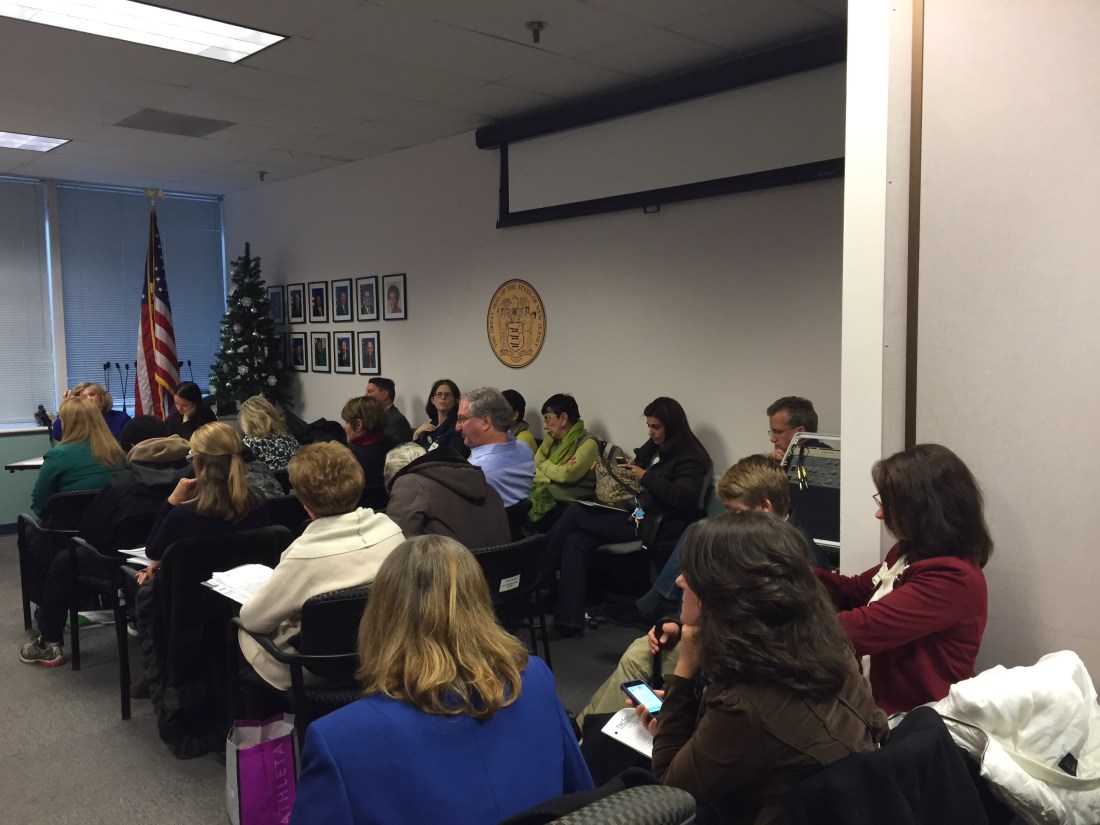
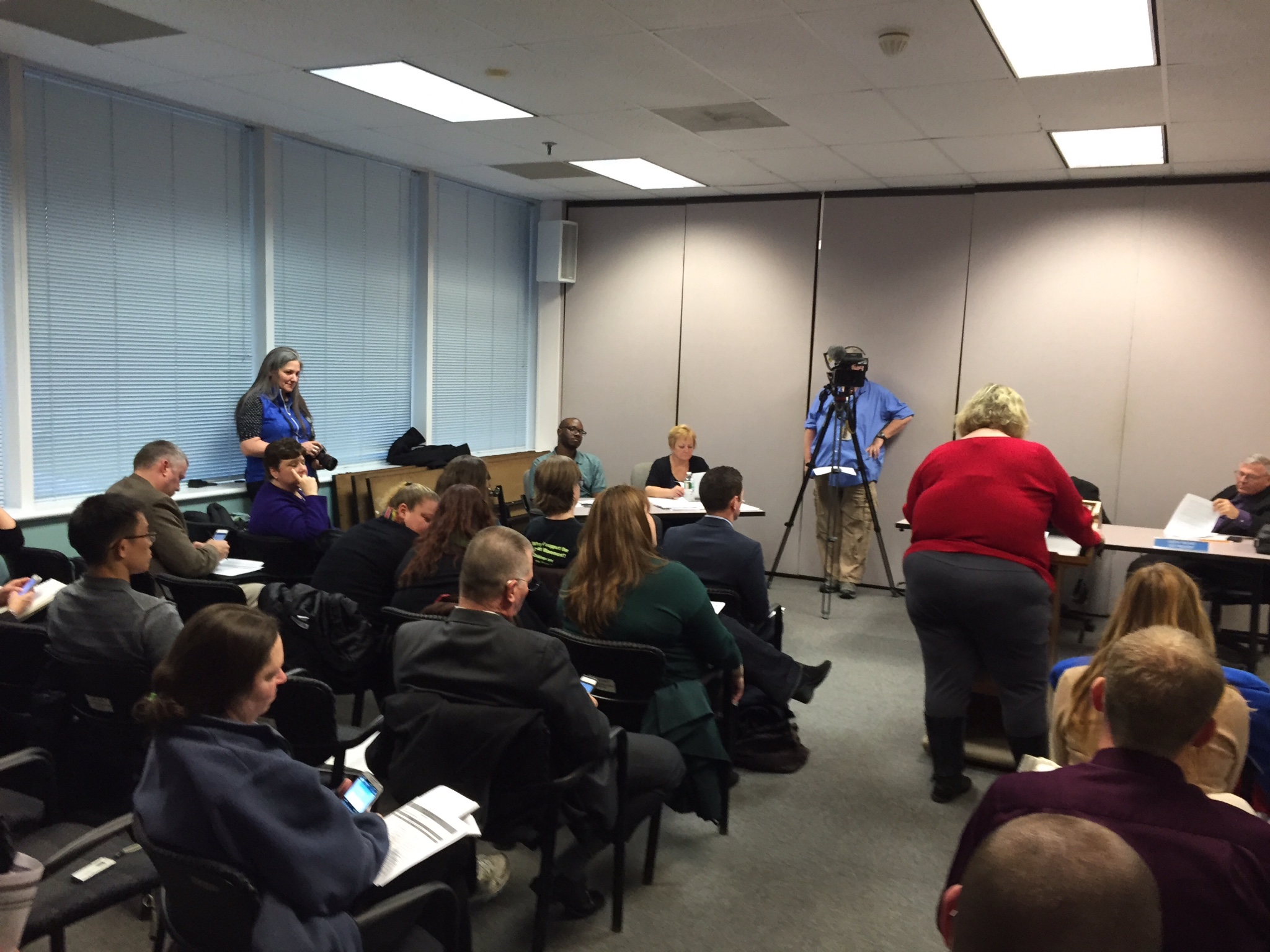
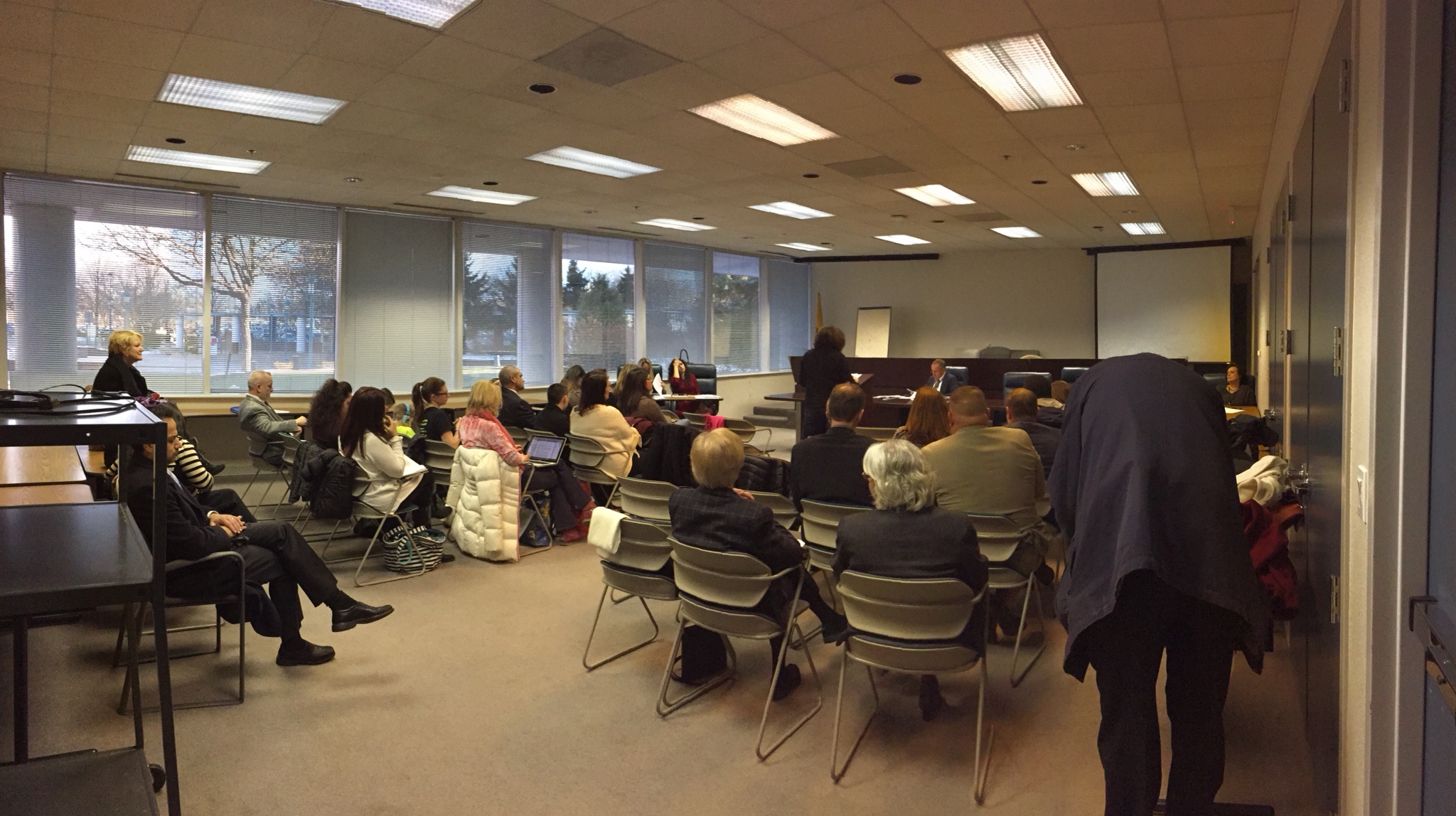
Here are both halves of Room A (with filming by the Asbury Park Press, as I understand it):

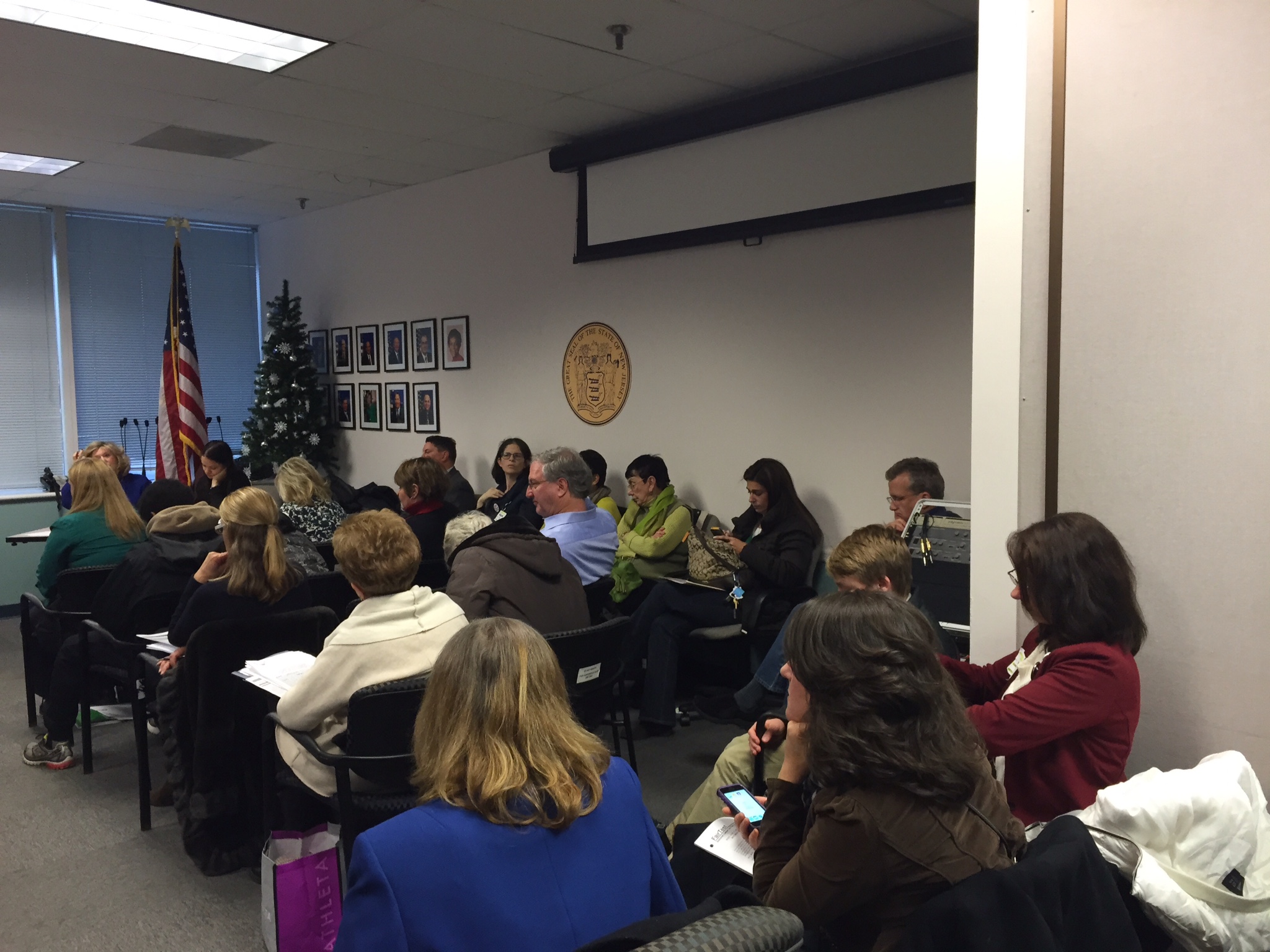
And here are both halves of Room B:


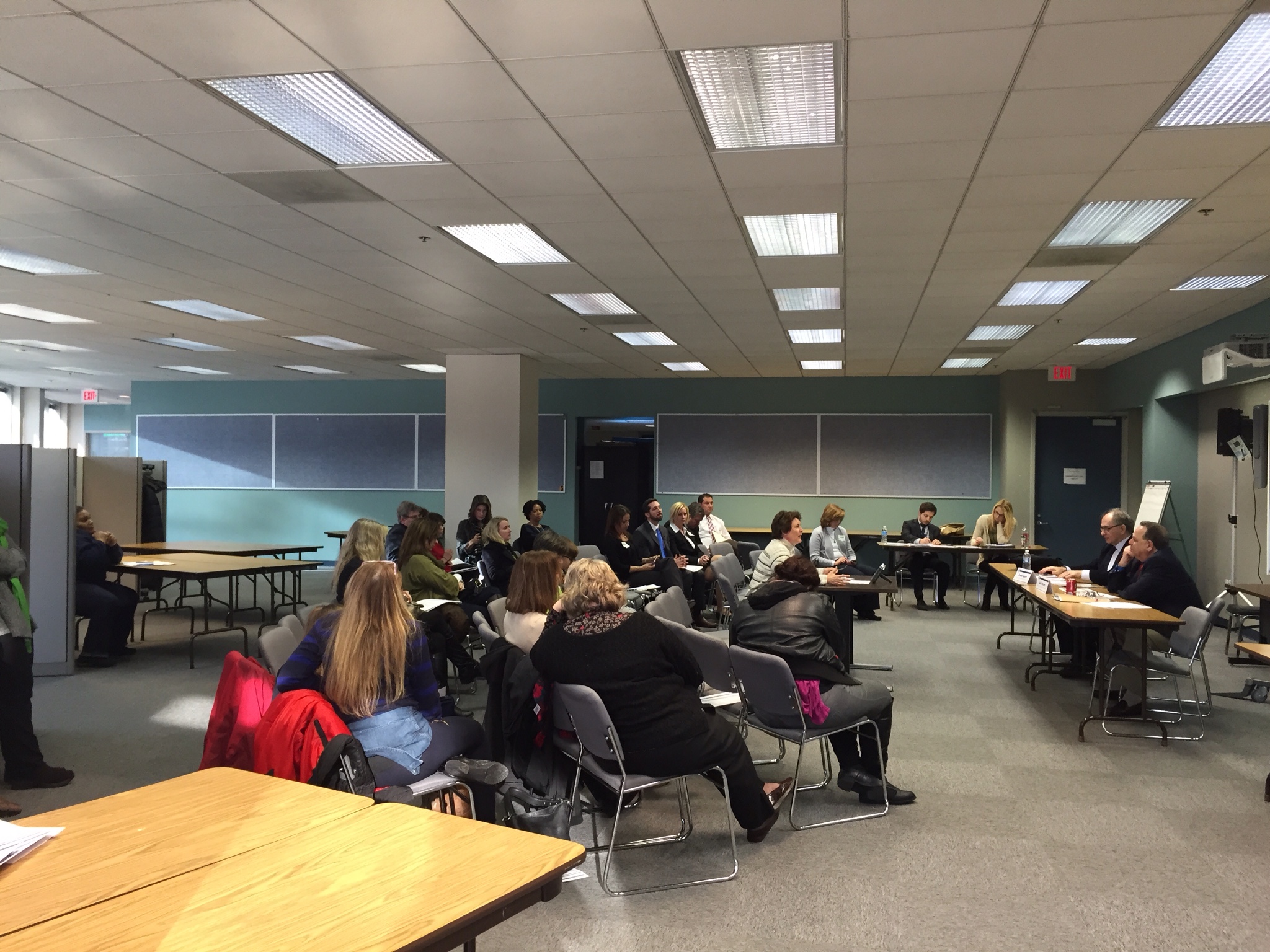
Here is Room C, where I testified:


And here is Room D:
As you can see, among the four rooms, there were a LOT of citizens, most of whom, like me, took a day off from work because we think it is important that the NJ State Board of Education hear from parents and students about the mess the PARCC is creating in our schools. I don’t have accurate numbers, because many people came to be supportive without speaking, but I’d guess that the turnout easily exceeded 100 people.
Perhaps the most gratifying part of the event for me personally was to hear from the half-dozen or so children who’d come to testify. Almost all of them told me that they’d been inspired to come testify by my daughter Elizabeth Blaine’s public comment to the Montclair Board of Education a couple of weeks ago, which I haven’t mentioned also led to us getting interviewed (to my enduring political chagrin, but it’s nice that we have common ground on something) on Fox News’s Fox & Friends morning show. Just in Room C, we heard from a 10 year old girl, a 7th grade girl, and a 9th grade boy. All three were opposed to PARCC and the related test prep.
It was also terrific to get to meet — in person — many of the fellow New Jerseyeans I’d only connected with virtually through our shared opposition to these tests. I’m only sad that because of the four-room set up, I didn’t get to meet a number of other terrific leaders that I know were there.
But the major takeaway from today is that there is a strong — and rapidly growing — PARCC refusal movement in New Jersey. And it was great to see members of the press, from the pieces that already appeared on the Star Ledger and the Asbury Park Press website to the appearance of reporters from NJ101.5 to The Alternative Press – Edison (and there may well have been other reporters I wasn’t aware of). Go readd the Star Ledger and Asbury Park Press articles: their reporters didn’t pull any punches today. The bloggers were out in full force too. Here’s a piece from Marie Corfield that contains some stunning news: following the comments he listened to today, the President of the NJBOE apparently stated publicly that they know that they can’t force kids to take this test. I’ll add more blog links as I come across them.
Take note, Commissioner Hespe. You declared war on the parents and students of New Jersey back in October, but we are organizing, we are rallying, and we are fighting back. I did note, however, that you were too cowardly to sit in any of those rooms to hear for yourself what the parents and students of New Jersey are saying. I heard from more seasoned activists that this was par for the course from you — you apparently don’t deign to bother with public comment. That’s all part and parcel with the CCSS/PARCC playbook, of course, which generally fails to prioritize democratic values. I don’t think your disappearing act gives you cover to continue claiming that New Jersey doesn’t have a growing opt-out/test refusal movement.
Watch out, Commissioner Hespe: this is one war we’re going to win.
Finally, Governor Christie, with your PARCC study commission that has not yet publicly released the preliminary report that was due on December 31, 2014, don’t think your teflon governor act is going to allow you to escape blame for imposing PARCC and Common Core on the people of New Jersey. Trust me, from the brief foray I made into the world of Fox News, your national base isn’t impressed with your Common Core and PARCC cheerleading. Your national ambitious may well hang on this issue.
We lefties won’t rally behind you on this either.
Ironically, Governor Christie, through your minion David Hespe, you are a uniter: you are uniting the left and the right, the rich and the poor, the white and the black, the native English speakers and the English Language Learners, in shared opposition to your market driven education reform policies — including, but not limited to, your imposition of PARCC onto the people of New Jersey. It was a powerful thing to watch as the wealthy and privileged parents from Basking Ridge made common cause with parents from Newark. We don’t resemble each other in race, socioeconomic status, or political affiliation. But one thing was clear: no matter what our backgrounds, none of us want you to dismantle our public schools.
And we all agree on one thing: education is a necessary ingredient for democracy. A policy aimed at dismantling public schools is a policy aimed at devolving democracy into demagoguery.
We won’t forget. And we won’t — we can’t — let you win.

NJ Governor’s Task Force: Take the PARCC, I Did


Dear Members of Governor Christie’s PARCC Task Force:

I was one of those kids who always performed well on standardized tests. As a result of my scores, I was placed in gifted and talented programs, tracked into the honors and AP tracks (with their added boosts of inflated GPAs), and ultimately accepted to a highly selective liberal arts college. I wasn’t a particularly conscientious student, and I brought all sorts of hangups to my classwork (Carol Dweck is my hero, as I was definitely one of those kids who often didn’t complete assignments at all out of what I now believe was fear that I wouldn’t measure up to my “smart” reputation). But standardized tests saved me, and gave me a chance to “prove” my worth. You’d think I’d be the biggest cheerleader out there for our new, next-generation standardized tests. After all, standardized tests enabled me to skate through school until I finally matured enough to become a conscientious student while studying for my first graduate degree. Standardized tests served me well, so isn’t it time for me to return the favor?

Given that standardized tests have served me so well, I approached the Partnership for Assessment of College and Career Readiness (“PARCC”) sample problems and sample tests with an open mind. I first sat down to try some of the third through fifth grade sample math problems about a year ago. After that review, my major objection was to the technology, which makes solving math problems and justifying answers harder rather than easier. That is still true (although admittedly, the technology seems better than it was in January of 2014 when I first looked at these). But more recently, I first really sat with and reviewed the 4th grade English Language Arts practice test. My real concern now is with the English Language Arts tests.

I have a fourth grade daughter. She was first identified for our district’s gifted and talented program for English Language Arts in kindergarten, as she came into kindergarten reading chapter books. Her vocabulary and analysis skills remain quite advanced for a child of her age. And I can tell you that she retains the ability to imagine. Do you remember that, the ability to imagine with ease? Do you remember your childhood, when you could create imaginary worlds and people them with imaginary characters just by wishing them into existence? Do you remember building forts and castles that were as real to you as could be? For a moment, for just a moment, I ask you to call upon what is likely your long-stagnated power of imagination. Imagine yourself at nine or ten years old. Imagine your room, imagine your friends, and imagine your school work.

Then sit down. Keep yourself in your nine or ten year old mindset. Boot up your desktop, or power up your laptop, or unlock your iPad. Navigate to the PARCC website, at parcconline.org. Navigate to the 4th grade English Language Arts PARCC practice test. Open it in front of you, right now, as you read this comment. If you refuse to sit down to take the sample tests yourself, then with all due respect I submit that farcical as this task force — with its 6 week window to issue recommendations — might be, you are not meeting you obligation as member of this task force. Remember as you work through the 4th grade PARCC practice test that you are not your current self — you are still your nine or ten year old self.

As you take the 4th grade English Language Arts PARCC test, stay in the head of nine or ten year old you. Imagine your nine or ten year old self reading the first story and the first poem. Imagine your nine or ten year old self trying to answer the questions regarding what evidence supports the meaning of certain words. I bet your nine or ten year old self can probably figure out the first answer. Your nine or ten year old self might even be about to figure out what evidence from the text supports that first answer.

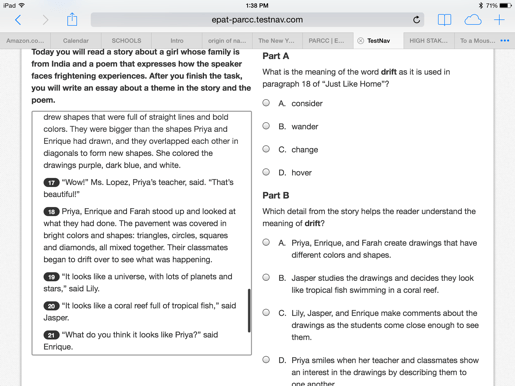
What about the kid who already knows the definition of the word drift?

Now move on to the setting question. Imagine your nine or ten year old self attempting to distinguish which choices describe the setting. Remember that this is a “gotcha” question, as all five possibilities are described in the story, but the answer key states that the “correct” answers are only those that pertain to the settings in Priya’s present, and not to those settings that form the background for her memories. Did your nine or ten year old self know that without me first revealing the answer? Does your nine or ten year old self think it’s fair or appropriate to expect our nine and ten year olds to intuit that distinction? If your nine or ten year old self thinks this is unfair, do you think your nine or ten year old self is going to keep devoting his or her best efforts to completing this test?

Apparently 4th graders are supposed to magically know that this question only refers to the present-day setting, not to the settings described in Priya’s memories.

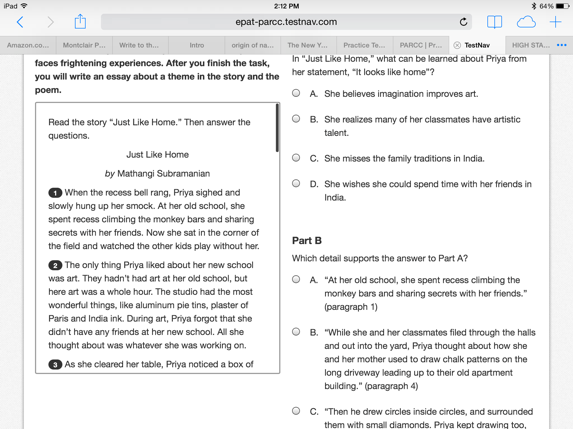
But keep imagining. Imagine, as you progress through the multiple choice questions, your nine or ten year old self constantly having to try to scroll up and down to get to the proper portion of the story that relates to the question. As you imagine, remember, as my ten year old daughter reported to me from one of her class’s PARCC practice sessions, that if you accidentally click outside the testing box as you scroll, you will be locked out of the remainder of the test. Imagine the anxiety you feel that you might accidentally mis-click.

I could make a reasonable argument for either B or C. What about you?

Now imagine your nine or ten year old self attempting to distinguish the structural elements that delineate the poem versus those that delineate the short story. Imagine your nine or ten year old self trying to relate to and analyze Maya Angelou’s poetry. Imagine your nine or ten year old self trying to figure out if “descriptions” applies to both.

I could argue that rhythm applies to both. What about you?

Finally, you’re up to the first essay. Now imagine your nine or ten year old self, hunting and pecking for each letter on the keyboard, trying to draft an essay in which you identify the theme of the poem and the theme of the story, and then to show how the characters in the story and the speaker in the poem “show” the theme. What themes did your nine or ten year old self pick? What does your nine or ten year old self think it means for the themes to be “shown through the characters”? Did your nine or ten year old self truly sit down and try to type out a well-written and intelligent answer to this essay? Did your nine or ten year old self remember to do this one finger at a time, laboriously hunting and pecking around the keyboard, now looking for a “c,” and later looking for an “f”? Did your nine or ten year old self write to the best of his or her ability, or did your nine or ten year old self just push to put something — anything — down on the screen as his or her frustration grew with the infernally slow progress of his or her typewritten thoughts? Does your adult self remember the frustration of trying to get your thoughts out on paper before your fingers could keep up with your brain?

What themes did you pick? Does the question require you to pick one common theme, or should you pick two separate themes? And how is a 9 or 10 year old going to explain “how the theme of the story is shown through the characters and how the theme of the poem is shown through the speaker,” anyway? Finally, if the PARCC consortium/Pearson actually believe that this question is appropriate for 9 and 10 year olds, why don’t they show us exemplars of actual student-written responses created under test-taking conditions?

Now, can you truly look me in the eye and tell me with a straight face that this is an appropriate task for our children?

Now, can you truly look me in the eye and tell me in all honesty that a child who cannot succeed on this task is not on track for college or a career?

Now, can you truly look me in the eye and tell me as if you mean it that preparing our children for this work is what their teachers should be spending the year doing?

Now, can you truly look me in the eye and tell me that your child self would believe that this test was fair, and would not give up before the end?

Now, can you truly look me in the eye and tell me with sincerity that years spent preparing for tests like these aren’t going to suck the joy, imagination, love of learning, and creativity out of children — and their teachers?

Can you truly?

My large extended family gathered this Thanksgiving for turkey and togetherness. At our gathering, at the risk of sounding like a broken record, I spoke with my retired elementary school librarian aunt, with my aunt who works for a private tutoring center, with my college freshman cousin, and with my cousins whose kids are in third and fifth grade. They like my writing and they’re impressed by my activism, but none of them had really made the leap to think that my education activism is something that is really about them and their kids or their grandkids. They thought that their kids — like mine — are privileged enough to be good students in good public schools, and that these tests were really about the other kids, the kids without privileges and advantages, and that this fight had nothing to do with them.

But then I opened up my iPad. And I navigated to the PARCC fourth grade ELA sample test. And I made them try to take it. Each of them was appalled. Outraged. Infuriated.

So this is my request to this task force. Don’t issue a report or make recommendations until you sit down — publicly so that we know that you did it — and actually try taking these sample tests.  That is, to maintain any credibility at all, the task force must host — and participate in — Take the PARCC events across the state.

After that, you can move on to the other issues. After that, you can make recommendations.

After that, you can look at how often Pearson makes mistakes in its textbooks, and whether it’s reasonable to trust a company that makes such mistakes to design high-stakes tests that will eventually determine our students’ class placement and/or college graduation.

After that, you can look why it is categorically unfair — not to mention demoralizing — to have teachers’ performance reviews dependent on the outcomes of these tests.

After that, you can look at whether these tests improve children’s educational outcomes.

After that, you can look at whether the high-stakes nature of these tests encourages widespread cheating.

After that, you can look at whether failures on these tests contributes to destabilizing schools and communities that serve our most challenged children.

After that, you can look at whether the high-stakes testing culture discourages highly qualified teachers from entering (or, as I can tell you in my case, from returning to) the teaching profession.

After that, you can look at what portions of our high local property taxes and precious school budgets are now paid to the for-profit industry that has sprung up around these tests.

After that, you can look at whether these tests are doing more harm than good.

After that, you can look at whether these tests are forcing schools to narrow the curriculum, as the requirement to devote school hours and resources to teaching to these tests means that those school hours and resources are not being used for other, more precious, lessons.

After that, you can look at whether these tests are stamping out our children’s imaginations even earlier than we lost the abilities to easily access our own imaginations.

After that, you can look at whether Acting Commissioner David Hespe of the New Jersey Department of Education should be instructed to revise his PARCC “opt-out” guidance to ensure that the child of any parent who conscientiously objects to his or her child serving as a guinea pig for these tests will be provided with an alternate education experience during testing.

After that, you can look at whether — assuming we agree that this is the purpose of public school, which we don’t — student performance on these tests will tell teachers, parents, and members of the community anything whatsoever about whether these 9 and 10 year olds are on-track for college and careers.

But first — first — you need to take the tests.

Sincerely,

Sarah Blaine, B.A. in English (Wesleyan University, Middletown, CT), M.A.T. in Secondary English (University of Maine, Orono, ME), J.D. (Rutgers University School of Law–Newark, Newark, NJ)

Asinine Arne’s Idiotic Idea

Update (12/6/14): The proposed rules have been published in the Federal Register.  There is a 60 day comment period.  Please go and comment (I submitted a slightly edited version of this post, of course). Here is the link: https://www.federalregister.gov/articles/2014/12/03/2014-28218/teacher-preparation-issues Thanks for your attention to and care regarding education and the preparation of new teachers.  Oh, and be forewarned that there is a 5,000 character limit in the online comment box, so if your comments exceed that (as mine obviously did), you will need to add them as a PDF or other document.

Update (12/2/14):  A slightly less “salty” version of this piece appeared on Valerie Strauss’s Washington Post blog, The Answer Sheet, today.  Here’s the link:  http://www.washingtonpost.com/blogs/answer-sheet/wp/2014/12/02/the-concept-education-secretary-duncan-has-entirely-missed/   To be honest, I actually like the WaPo piece better.  I think that toning down the raw edges of this piece increases its impact.  So please feel free to read in either place and let me know what you think.

The pre-Washington Post piece appears below:

When it comes to U.S. Secretary of Education Arne Duncan and his asinine ideas, it’s hard to figure out which idea is the worst of the worst. But I think we have a winner. On November 25th, the New York Times published an article titled, “U.S. Wants Teacher Training Programs to Track How Graduates’ Students Perform.” Yes, you read that correctly. When an aspiring teacher graduates from her teacher education program, that program will be ranked based on how the aspiring teacher’s students perform (on standardized tests). And, even worse, programs that fail to generate higher student performance (never mind whether some are sending teachers to suburban classrooms full of privileged children while others are sending new teachers to the rural or urban trenches) will lose some federal funding if their alumni’s students fail to perform. Now, please bear with me. Out here in lawyer-land, there’s a slippery concept that every first year law student must wrap her head around: it’s the idea of distinguishing between actual (or “but for”) causation and proximate (or “legal”) causation. Actual causation is any one of a vast link in the chain of events from the world was created to Harold injured me by hitting me, that, at some level, whether direct or attenuated, “caused” my injury. For instance, Harold couldn’t have hit me if the world hadn’t been created, because if the world hadn’t been created, Harold wouldn’t exist (nor would I), and therefore I never would have been hit by Harold. So, if actual or “but for” causation was legally sufficient to hold someone responsible for an injury, I could try suing “the Creator,” as if the Creator is somehow at fault for Harold’s decision to hit me. Well, that’s preposterous, even by lawyer standards, right? The law agrees with you: the Creator is too far removed from the injury, and therefore cannot be held legally responsible for it. So to commit a tort (legal wrong) against someone else, it isn’t sufficient that the wrong allegedly committed actually — at some attenuated level — caused the injured’s injury (i.e., that the injury would not have happened “but for” some cause). Instead, the wrong must also be proximally related to that injury: that is, there must be a close enough tie between the allegedly negligent or otherwise wrongful act and the injury that results. So while it would be silly to hold “the Creator” legally responsible for Harold hitting me, it would not be similarly silly to hold Harold responsible for hitting me. Harold’s act was not only an actual or “but for” cause of my injury, it was also an act closely enough related to my injury to confer legally liability onto Harold. This is what we lawyers call proximate (or legal) causation: that is, proximate causation is an act that is a close enough cause of the injury that it’s fair — at a basic, fundamental level — to hold the person who committed that injurious act legally responsible (i.e., liable to pay damages or otherwise make reparations) for his act. [As an aside to my aside, if this sort of reasoning makes your head explode, law school probably isn’t a great option for you.] Well, it appears that Arne Duncan would have failed his torts class. You see, Arne didn’t get the memo regarding the distinction between actual causation and proximate causation. Instead, what Arne proposes is to hold teacher prep programs responsible for the performance of their alumni’s K-12 students (and to punish them if their alumni’s students don’t measure up). Never mind the myriad chains in the causation link between the program’s coursework and the performance of its graduates’ students (presumably on standardized tests). Arne Duncan somehow thinks that he can proximally — fairly — link these kids’ performance not just to their teachers (a dicey proposition on its own), but to their teachers’ prep programs. Apparently Arne can magically tease out all other factors, such as where an alumna teaches, what her students’ home lives are like, how her students’ socio-economic status affects their academic performance, the level of her students’ intrinsic motivation, as well as any issues in the new alumna’s personal life that might affect her performance in the classroom, and, of course, the level of support provided to the new alumna as a new teacher by her department and administration, and so forth. As any first year law student can tell you, Arne’s proposal is asinine, as the alumna’s student’s test results will be so far removed from her teaching program’s performance that ascribing proximate causation from the program to the children’s performance offends a reasonable person’s sense of justice. [Not to mention the perverse incentives this would create for teaching programs’ career advising centers — what teaching program would ever encourage a new teacher to take on a challenging teaching assignment?] So what’s the rationale for Asinine Arne’s Idiotic Idea?

“The last thing they want or need is an easy A,” Mr. Duncan said. “This is nothing short of a moral issue. All educators want to do a great job for their students, but too often they struggle at the beginning of their careers and have to figure out too much on the job by themselves.”

I graduated from a teacher prep program. I earned an M.A.T. (Master of Arts in Teaching) from the University of Maine, where my concentration was in teaching secondary school English. And Arne both is and isn’t wrong. There is no question that my M.A.T. program could have been a year of easy A’s for me. There was a lot of work, but it’s true, I didn’t really find the intellectual work of the classes themselves particularly challenging. However, I made a decision — and I don’t think I was alone among teachers in making this decision — that if I was going to have the moral authority as a teacher to ask my students to work to the best of their ability, then I had to have had the experience of working to the best of my academic ability. So, I really worked my tail off in that program because I felt it was important for me to do so, not because the courses themselves really demanded that level of work. And yes, for whatever it’s worth, I graduated with a perfect GPA. But as I understand it, perfect GPAs common in many graduate programs, not just education. That being said, I had a few terrific professors in my M.A.T. program (Ted Coladarci for Educational Psychology comes to mind) and I had my share of ho-hum to pretty awful professors there as well (I won’t name names, but my personal “favorite” was the all-but-dissertation grad student who taught us nothing but then required us to write an end-of-course reflection paper about the transformative experiences we’d had in her course — a lot of alcohol enabled me to draft 57 lies in 4 pages). But good, awful, and in-between, that 13 month teacher prep program also provided me with a strong grounding in the theoretical — and practical — components of running my own classroom. Our program started in mid-June (on my birthday, in fact), and after a summer of intense theory, from the first day public schools were in session that fall, we were in actual classrooms with actual students. At first we observed, met regularly with our mentor teachers, and began designing lessons to meet our students’ needs. As the fall semester progressed, we taught some lessons in our practicum classes. Then, in the spring semester, we student taught full time (we each had two 8 week placements) for the entire semester (our academic courses met in the late afternoons and evenings). That spring, I was responsible for teaching — under the guidance of and with the help of my mentor teachers — full rosters of students. After the spring semester ended, we returned to straight classroom work for the summer to round out our education coursework. When I began my first teaching job the following fall, I was as well-prepared as I think I could be, but I was also unprepared, because there is a huge gap between a student teacher, who benefits from the gravitas and classroom management accountability instilled by her mentor teachers, and a brand new teacher who must, for the first time, create the gravitas and accountability necessary to effective classroom management on her own. It isn’t that my academic preparation was bad — it really wasn’t — it’s simply that there is a fundamental divide (even with the year of practicum and student teaching experience our program afforded us) between studying how to do something and actually doing that thing yourself. After teaching for a couple of years, for a whole variety of reasons, I left the classroom, moved back near my family in New Jersey, and decided to apply to law school. I am here to tell you that my law degree provided me with far, far less practical experience than my M.A.T. degree. For those of you who aren’t familiar with how law school works, at a typical law school you take a standardized curriculum the first year. Pretty much every first year law student in this country studies Contracts, Torts, Property, Criminal Law, Civil Procedure, Constitutional Law, and Legal Research & Writing in her first year of law school. During the following two years, law students take a variety of electives, although most law students make sure to take a few other basic classes during those years: i.e., Corporations, Evidence, and maybe Criminal Procedure. In Legal Research & Writing a law student writes a few legal memoranda and a couple of legal briefs. In the entire year long course, I think we finished four major pieces of writing (two memos, a summary judgment brief, and an appellate brief). What we don’t learn in law school is anything practical. We don’t learn how to draft the supporting papers for our motions, we don’t learn how to talk to adversaries on the phone, we don’t learn about scheduling orders and negotiating confidentially agreements, and we don’t learn how to interview clients. We certainly don’t learn how to review documents, create deposition outlines, or draft contracts. Anything practical we learn during our law school years we learn from our summer internships: I learned a fair amount interning for a Third Circuit Court of Appeals judge after my first year of law school, and even more as a second year summer associate at the large firm I joined upon graduation. And for the record, as with my teaching program, I had some terrific law school professors (Claire Dickerson and Diana Sklar come to mind), and I had some pretty awful law school professors. Frankly, that was my experience from elementary school through the end of law school — some teachers were awesome for me, others, not so much. When I left my M.A.T. program to begin my first year as a teacher running my own classroom, it took me a bit of time to get my sea legs as far as classroom management went, but my professional program had provided me with the tools to get there. When I graduated from law school (and FYI, I graduated with high honors, so the issue isn’t one of not being able to hack law school), finished studying for and taking the bar exam, and actually started my first job, I knew nothing. More experienced attorneys had to walk me — step by step — through how to do everything from how to put together a motion to how to take a deposition. The point of this Very Long BlogPost is that Asinine Arne has, to my mind, entirely missed the point. No professional academic program can 100% prepare you to hit the ground running in your career. Rather, professional expertise is something you develop over years of actually practicing your profession — and the further you progress in your career, the more you appreciate the theoretic base you learned in your academic preparation. I’m a far better lawyer in my tenth year of practice than I was in my first, and I imagine that if instead I was a 15th year teacher this year, I’d be a heck of a lot better at teaching than I was when I left the classroom after two years of teaching experience. That being said, compared to law school, there is no question that my M.A.T. program gave me the skills I needed to develop professional expertise, and frankly, it did a far better job of teaching practical skills I’d need in my classroom than law school did at teaching practical skills I’d need in the courtroom. Arne says:

“All educators want to do a great job for their students, but too often they struggle at the beginning of their careers and have to figure out too much on the job by themselves.”

Figuring out how to do the job by yourself is the key to developing from a student into a professional, whether you’re a teacher or a lawyer. At some point, every professional must make this transition, and all of the training in the world can’t substitute for the on-the-job experience that transforms a recent professional program graduate into a seasoned veteran. Actual professionals know this. It’s too bad Asinine Arne didn’t get the memo. P.S.: Arne Duncan has been secretary of education for six years, and in that role he is ultimately responsible for the educational progress of all U.S. students. According to the most recent PISA results, U.S. students’ scores haven’t improved on Duncan’s watch. Therefore, by Duncan’s own logic, I propose that we deprive his alma mater — Harvard University — of some federal funding for its current students because Duncan’s failure to improve U.S. PISA scores demonstrates that Harvard (which educated Duncan) is responsible for U.S. students’ flat scores on the PISA exam. If Duncan and Harvard don’t like the logic of my modest proposal, then Duncan should withdraw his proposed scheme for rating teacher preparation programs based on the educational outcomes of their alumni’s students, as my logic simply tracks his own.

Montclair Times Letter to the Editor

Good Morning and Happy Thanksgiving!  At the moment, in addition to all of the usual things I’m thankful for (family, including a house full of people and a huge 51 person family Thanksgiving feast this afternoon; snow; friends; and the good fortunes of good health, a decent job, and the good fortune to be able to live a pretty decent life), I’m thankful for my fellow citizens here in town who are speaking up against the takeover of our schools by high-stakes standardized testing (specifically, PARCC).  There were three letters to the editor in yesterday’s local paper, The Montclair Timesquestioning or opposing PARCC in our schools, including mine, which I have reposted below. The momentum is building locally to just say no to these high-stakes tests.  Especially in a town like Montclair, where our school board is appointed, not elected, the Opt-Out movement (and mass opt-out at the local level) is how we parents can, at a grassroots, local level, vote to say no to the test-focused realignment of our public schools.  Happy Thanksgiving, Acting Commissioner David Hespe.

To the Editor:

The name says it all: the new Partnership for Assessment of College and Career Readiness (“PARCC”) standardized test our district must offer to our 3rd-11th graders this spring reflects what its developers believe is the purpose of public school: to prepare children for college and careers.

They are wrong. The purpose of public education is — and should be — far more lofty: to educate inquisitive, analytical, and thoughtful citizens prepared to cast educated votes and participate in thoughtful analysis and debate should they be chosen as jurors. Readiness for college and careers is a by-product of that goal, but the goal is preparation for effective citizenship, not vocational training for employment.

I’ve been a Montclair schools parent for five years now, and while I applaud many of our public schools’ offerings, my older daughter’s school experience has been shockingly bereft of social studies education. Discussions with teachers and administrators reveal the reason: where the PARCC reigns supreme, the curriculum narrows. There is no time for social studies beyond map skills, an occasional out-of-context project, and the ubiquitous pre-digested and uncontroversial Scholastic News.

What happened to classic elementary school fodder such as current events, studies of world cultures, inquiries into genealogy and family history, research into Native American cultures, immersive units studying Ancient Greece, Rome, Egypt, China, or Mesopotamia, and even the most basic American history? The often-whispered answer is that these units were casualties of the PARCC assessment: PARCC doesn’t test social studies, so our schools don’t teach it.

Montclair is one of the rare New Jersey suburbs with a rich history of refusing to standardize itself. Say no to off-the-shelf standardized education. Start demanding citizenship-focused public schools by refusing the PARCC.

Sincerely,

Sarah Blaine

Montclair (and Beyond), It’s Time For Action

Almost eight years ago, my family was trying to figure out where — in New Jersey — to buy a house and put down roots. I’m a Jersey girl, born and bred. I grew up in Short Hills, and attended the Millburn Public Schools for 13 years. As my local readers know, the Millburn Public Schools are consistently considered some of the highest performing schools in the state. However, in March of my senior year of high school, our family moved to Montclair. I commuted back to Millburn for the last few months until I graduated, but the following fall my brother began his sophomore year as a student at Montclair High School. At the end of that year, my family moved back to Short Hills, so that my brother graduated from Millburn High School.

When it came time for us to decide where to raise our kids, school quality was a primary factor as we tried to decide where to put down roots. We considered towns all over northern New Jersey. When talk turned to Montclair, I called my brother. I asked him to comment on the quality of his education in Millburn versus in Montclair’s far more diverse (and less highly ranked) public high school. He said:

“Do I think it’s possible I got into a slightly better college because we moved back to Short Hills? I don’t know, I guess that’s possible. But I learned more about life and people and how to get along in the world in my one year in the Montclair Public Schools than I learned in my twelve years in the Millburn Public Schools — and those are lessons I still carry with me every day.”

I was sold.

Almost eight years after that conversation, I now have two children enrolled in the Montclair Public Schools. Almost universally, I have been thrilled with my daughters’ teachers, who have been thoughtful, dedicated, experienced professionals.

But things are changing. Our test-taking focused national, state, and now local culture threaten the values that make Montclair unique: by insisting that all children must learn all things in lockstep, we deviate from education best practices. And by accepting — without question — a test-taking culture that imposes hours and hours of standardized testing on our 8, 9, and 10 year old children, without carefully reviewing these tests and pushing back as a community where we believe the tests are poorly designed, developmentally inappropriate, and leading to intense pressure to narrow curriculum to meet the tests’ demands, we are stepping away from the community values that make Montclair special. Our schools should be — and historically, through our all-magnet public school system, have been — tailored to meet our children’s needs, but now we seem to be under pressure to tailor our children to meet state and federal politicians’ and bureaucrats’ unrealistic expectations — and if we don’t, our schools will be declared failures.

So what can we — as parents — do?

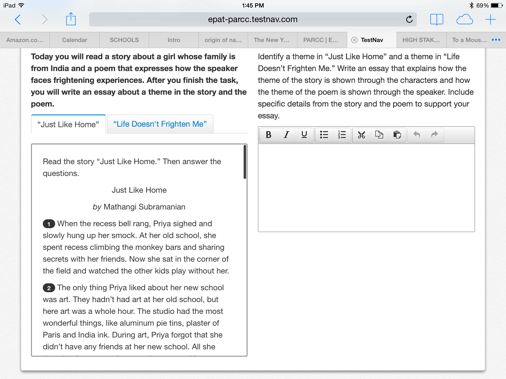
First, we must educate ourselves. If you’re reading this, you know how to read and write. So take an hour. Sit down and work through the 3rd or 4th or 5th grade English Language Arts sample exam, which is available at parcconline.org/practice test . Think of yourself at 8, 9, or 10 years old. Ask yourself whether these questions strike you as fair, whether you could make arguments in favor of more than one of the responses, and whether you think that we as a community should allow our schools to be judged based on our students’ performances on these exams. Here is a sample essay question from the 4th Grade English Language Arts test to get you started:

Identify a theme in “Just Like Home” and a theme in “Life Doesn’t Frighten Me.” Write an essay that explains how the theme of the story is shown through the characters and how the theme of the poem is shown through the speaker. Include specific details from the story and the poem to support your essay.

[As an aside, yes, we are asking 9 year olds to identify themes in two different stories (whether they are supposed to be the same theme or unrelated themes is unclear from the prompt), and then to explain “how the theme of the story is shown through the characters” and “how the theme of the poem is shown through the speaker.” I have a masters in teaching high school English, and I’m not really sure what that means. Are they asking for examples of how the character’s/speaker’s actions demonstrate the theme(s)?]

Second, if, after reviewing the tests yourself, you find that you have concerns about these tests, think seriously about refusing these tests on behalf of your children. There are all sorts of Facebook groups for parents who are thinking of opting-out (for e.g., there’s one called Opt Out of Standardized Tests – New Jersey).  Talk with your children about this. You will start to hear that your kids will not be alone if they refuse these tests. There is strength — and power — in numbers. And I’ve found that the front-line educators in our schools will at least quietly applaud your efforts. The school culture may be such that they are not comfortable speaking up publicly, but they know right from wrong when it comes to educational practice. Mention that you’re thinking of joining the opt-out movement, and you will see eyes light up.

Third, speak up. Attend Board of Education meetings to make your voice heard. Talk with other parents. Write letters to the editor and op-eds. Call and write to your legislators. Contact the Board of Education — at both the state and local levels. Demand that our local Board of Education immediately issue its position regarding the opt-out/refusal movement, and demand that they make alternate learning opportunities available to our kids.

Fourth, suggestion alternates to a testing-focused culture. We can evaluate our kids’ learning in different — but more effective — ways. For instance, we can demand that our district evaluate kids’ progress toward achieving standards by asking schools to work with students and parents to compile portfolios of student work or require students to complete capstone-type projects at critical junctures. I taught high school in rural Maine at the turn of the millennium and we were able to make the portfolio and senior project approach work there. There is no reason we can’t manage the same here in Montclair. Standards-based assessment does not require standardized testing.

Fifth, demand detailed local coverage of Board of Education meetings. Many people (including me, but I was far from alone) spoke at the BOE meeting on Monday, November 17, 2014, but it is now more than a week later and the only coverage I saw in our local media (print and online) was a small Montclair Times article regarding a tiny subset of what was discussed (it discussed only the process by which the BOE can respond to questions posed at meetings). But The Montclair Times failed to do a comprehensive article regarding the meeting, and Baristanet, Patch, and The Alternative Press were completely silent.  [UPDATE: At 7:42 on Tuesday, November 25, 8 days after the meeting was held, Baristanet ran this story, which does attempt to summarize the public comment portion of the meeting, but still does not summarize the three reports to the BOE, nor the illuminating BOE discussion after public comment ended.]  We don’t know what’s happening unless we have journalists covering these issues.

And yes, Montclair Cares About Schools did a terrific email summarizing the last BOE meeting, but as much as I tend to agree with them on many issues, I recognize that this is an email from citizens summarizing their point of view, and that while I think it was a quite accurate summary, I’m not sure this was always true of all of their characterizations of BOE materials in the past, and more generally speaking, the MCAS email doesn’t have the same authority as an unbiased news source that our local news outlets at least theoretically have.  I can’t find a link to the email on their blog, but the Montclair Cares About Schools blog, Montclair Voices, does contain a bunch of the public comments made at last week’s meeting.  Similarly, our Montclair teachers’ points of view (and a bunch of their public comments to the BOE last week) are reflected on our teachers’ new blog, Montclair Education Matters.

High quality — and diverse — schools are what brought many of us to Montclair, and they are what keep us here. We need to unite as a community to reject externally-imposed policies (whether imposed by NJDOE or the USDOE) that stand between our children and the well-rounded educations our children deserve — and that our teachers know best how to provide.  And that includes educating and supporting our local school board members so that they have the knowledge, community support, and tools to stand with us at the front lines of saying no to so-called “education reform” that is bad for our children, bad for our schools, and bad for our community.

BOE: Provide the District’s PARCC Opt Out Policy

Update:  The local access channel was able to post the BOE meeting on its website today.  I am not computer savvy enough to figure out how to take a clip of my 3 minutes, but I can tell you that I start at the 2 hour and 30 minute mark on this link:

http://vp.telvue.com/player?id=T01411&video=217601

If someone knows how to grab my snippet and put it on YouTube, I’ll link it that way instead.

Original Post:

Here is the text of my prepared remarks for tonight’s local Board of Education meeting.  I think I deviated a litte bit — but not very much — from what’s written here.  If I can figure out how to get a snippet of the video, I will add that to this post (embarrassing as that might be).  Please note that my comments were limited to 3 minutes.

I am here today to ask the District to formally state — in writing to all parents — its policy regarding how children who are refusing the PARCC exams will be accommodated.

I attended the District’s October 23rd PARCC Family Presentation, where Gail Clarke was asked to comment regarding the district’s opt-out or refusal policy for the PARCC exams. She stated that no policy was in place because the State DOE had not yet issued its guidance regarding opt-out decisions.

A week later, on October 30th, the New Jersey Department of Education issued “guidance” to school districts stating that districts were under no obligation to provide educational alternatives, and suggested — but did not require — that districts update their attendance and discipline policies to address PARCC opt-out issues.

NJDOE’s guidance is at odds with Montclair’s prior policy.

So, given the conflict between Montclair’s NJASK opt-out policy and the State’s recent guidance, I am here to ask what Montclair’s policy will be for handling PARCC refusals. And, as a parent, I am here to urge you to adopt an accommodating and humane policy.

I’ve reviewed the 3rd and 4th practice exams and sample questions on the PARCC website. I found many questions confusing and developmentally inappropriate — frankly, the “gotcha” feel of these questions reminded me of the New Jersey Bar Exam.

I am also concerned that we are asking students as young as 8 to compose essay responses on computers when the district hasn’t provided comprehensive typing instruction.

But I am most concerned about the narrowing of the curriculum in response to testing pressures: in particular, I worry about how little social studies education my 4th grader has seen compared to what I’d studied — in a NJ public school — by her age. Where are the units studying mythology, genealogy, Native American culture, American history, and the ancient world? Our district’s lack of social studies education is a sad disappointment — and a direct result of our testing-focused culture: Social Studies gets short shrift because it is not on the test. Elementary school social studies should be more than “map skills.”

I try to avoid making decisions without access to all of the facts, which is why I’ve reviewed the PARCC sample materials in depth. So before I make a final decision regarding the PARCC exams, I would like to review the District’s PARCC opt-out policy.

This is an urgent matter, given that my daughter reports that her class has already lost at least 6 periods of instructional time to PARCC preparation, including last week when her class was asked to attempt an End of Year math practice test before the children had been presented with many of the topics tested.

Thank you.